


What's Happening?
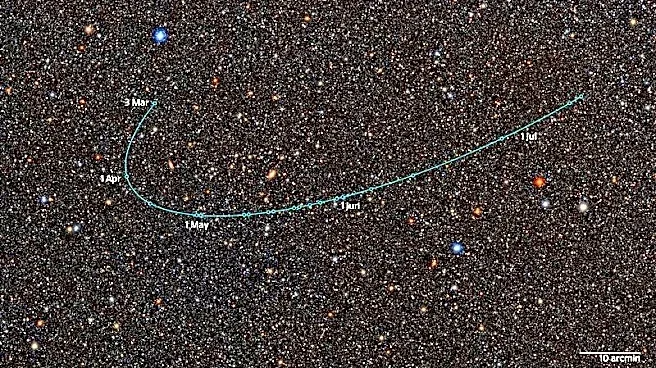
New radio observations have revealed that Betelgeuse, a red supergiant star located approximately 650 light-years from Earth, is experiencing atmospheric disruption caused by its smaller stellar companion, Siwarha. Siwarha, named 'her bracelet' in Arabic,
orbits so closely to Betelgeuse that it passes through the supergiant's extended atmosphere, creating a wake similar to a boat slicing through water. Lynn Matthews, principal research scientist at Massachusetts Institute of Technology (MIT) Haystack Observatory, led the observations using data collected from 2021 to 2026 from the Karl G. Jansky Very Large Array in New Mexico and the Atacama Large Millimeter/submillimeter Array (ALMA) in Chile. The data showed that Betelgeuse's atmosphere changes shape, becoming egg-shaped when Siwarha is farthest away and rounding out when the companion passes in front or behind it. The observations also confirmed Betelgeuse's recovery from the 'Great Dimming' event of 2020.
Why It's Important?
This discovery provides crucial insights into the dynamics of red supergiant stars and how close stellar companions can influence their atmospheres. Betelgeuse's long-standing mystery of a 2,100-day brightening and dimming cycle has been a subject of scientific debate, with recent studies pointing to the existence of a low-mass companion. The confirmation of Siwarha's disruptive effect on Betelgeuse's atmosphere helps explain these observed variations and offers a unique opportunity to study the complex interactions within binary star systems. Understanding how red supergiants shed material as they approach the end of their lives is vital for comprehending stellar evolution and the processes that enrich the universe with heavier elements. The influence of a close companion on this material shedding could significantly alter our models of supernova precursors and the subsequent formation of new stars and planetary systems.
What's Next?
To further confirm and understand the effects of Siwarha, researchers plan to observe more of the companion's orbit, particularly at radio frequencies that have been sparsely sampled. The planned Next Generation Very Large Array telescope is expected to make this type of monitoring more routine, providing sharper vision to study how red supergiants like Betelgeuse lose their material. These future observations will help scientists refine their models of stellar atmospheres, binary star interactions, and the life cycles of massive stars. Continued monitoring will also provide more data on Betelgeuse's recovery and its long-term behavior, potentially revealing more about the mechanisms behind its periodic dimming and brightening. This ongoing research will contribute significantly to our understanding of stellar astrophysics.
Beyond the Headlines
The interaction between Betelgeuse and Siwarha offers a fascinating glimpse into the violent and dynamic processes occurring in the cosmos. The concept of a 'cosmic poltergeist' disrupting a star's atmosphere evokes the powerful, unseen forces at play in the universe. This phenomenon highlights that stars are not isolated entities but are often part of complex systems where gravitational and atmospheric interactions can profoundly alter their evolution. The study also underscores the continuous refinement of astronomical observation techniques, with radio astronomy providing unique perspectives that complement optical data. The ability to detect such subtle atmospheric changes from hundreds of light-years away is a testament to human ingenuity and technological advancement in space exploration. Ultimately, these findings deepen our appreciation for the intricate dance of celestial bodies and the profound interconnectedness of cosmic events.