




What's Happening?
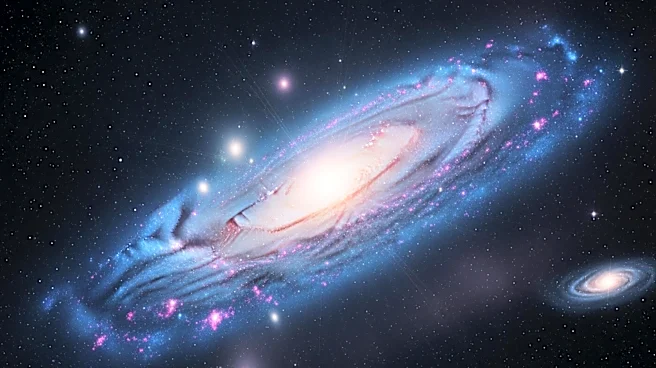
The Dark Energy Spectroscopic Instrument (DESI) has successfully completed its planned 3D map of the universe, exceeding expectations by observing over 47 million galaxies and quasars. This achievement marks a significant milestone in the study of dark
energy, a mysterious force driving the universe's accelerated expansion. DESI's map will allow researchers to explore the universe's structure and evolution, providing insights into dark energy and dark matter. The project, which began in 2021, overcame challenges such as the COVID-19 pandemic and natural disasters, demonstrating the resilience and dedication of the scientific team.
Why It's Important?
The completion of DESI's 3D map represents a major advancement in cosmology, offering unprecedented data to study dark energy and dark matter. Understanding these forces is crucial for explaining the universe's accelerated expansion and could lead to revisions of the standard model of cosmology. The map's data will help scientists explore the universe's large-scale structure, offering insights into the distribution of galaxies and the role of dark matter. This research could have profound implications for our understanding of the universe's past, present, and future.
What's Next?
With the initial mission complete, DESI will continue to collect data, focusing on more distant and faint galaxies to enhance the map's detail. Researchers will analyze the full dataset, with the first dark energy results expected in 2027. The ongoing study of dark energy and dark matter will involve examining nearby dwarf galaxies and stellar streams. These efforts aim to refine our understanding of the universe's composition and the forces shaping its evolution. The scientific community anticipates that DESI's findings will lead to groundbreaking discoveries in cosmology.