




What's Happening?
Filmmaker Gianfranco Rosi's 2025 documentary, which received a special jury prize at the Venice International Film Festival, highlights the decades-long work of Japanese archaeologists from the University of Tokyo. This team has potentially uncovered
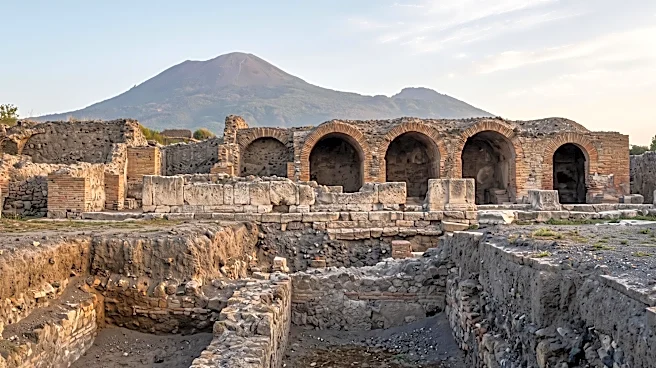
the lost villa of Roman Emperor Augustus on the northern slopes of Mount Vesuvius. The excavation, led by Professor Masanori Aoyagi and initiated in 2002, focused on the Somma Vesuviana site. Initial findings in the early 2000s revealed structures from the second century AD, buried by a 472 AD eruption, leading researchers to initially dismiss a connection to Augustus. However, a crucial turning point in 2019 led to the discovery of deeper architectural remains, clearly showing destruction from the 79 AD Vesuvius eruption. These findings include an extensive heating system with seven furnaces, suggesting a monumental bath complex belonging to a highly influential individual, consistent with historical accounts of a sanctuary built at the site of Augustus's death.
Why It's Important?
The potential identification of Emperor Augustus's villa represents a significant discovery in modern ancient history research. Augustus, who reigned from 63 BC to 14 AD, was Rome's first emperor, and his rule brought a period of stability to Roman history. While historical records detail the circumstances of his death, the exact location has remained elusive for centuries. The 79 AD eruption of Vesuvius, occurring approximately 66 years after Augustus's death, preserved but also concealed many luxurious villas in early imperial Campania. If further evidence unequivocally confirms the villa's identity, it will provide a tangible link to the final days of the empire's founder, offering invaluable insights into Roman imperial life and architecture. This discovery also contributes significantly to disaster archaeology, challenging previous assumptions that the northern side of Vesuvius was spared the worst effects of the 79 AD cataclysm, as thick ash layers have been found.
What's Next?
The Japanese expedition will continue its work to gather additional evidence to definitively confirm the villa's identity. Such confirmation would solidify this as one of the most important archaeological finds in recent history. The ongoing excavations at Somma Vesuviana will likely continue to yield data crucial for understanding the impact of volcanic eruptions on ancient settlements and the resilience of Roman communities. The documentary by Gianfranco Rosi serves to bring this archaeological endeavor to a wider audience, emphasizing not only the ruins but also the physical and intellectual challenges faced by the archaeologists. Future research will focus on meticulous documentation and analysis to ensure the preservation and understanding of these ancient cultural values for future generations.
Beyond the Headlines
This archaeological discovery, brought to light through Rosi's documentary, underscores the enduring power of historical inquiry and the role of modern technology, including filmmaking, in preserving and interpreting the past. The site's history, with its repeated rebuilding after volcanic eruptions, highlights the continuous demographic appeal of the region and the adaptive nature of Roman civilization in the face of natural disasters. The initial misidentification of the site's age and the subsequent deeper excavation illustrate the iterative and often challenging process of archaeological research. Furthermore, the political redirection of resources by Benito Mussolini in the 1920s, favoring Pompeii over this site, serves as a historical footnote on how political agendas can influence scientific endeavors and the course of discovery.