







What's Happening?
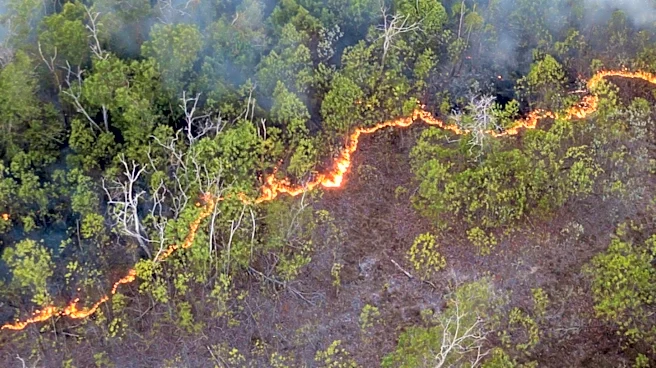
Southeast Asia is grappling with substantial economic costs due to the ongoing transboundary haze crisis, primarily stemming from forest and peatland fires in Indonesia. This environmental problem is severely impacting key industries across the region,
including agriculture, manufacturing, tourism, and aviation. Analysts indicate that the toxic smog, which has blanketed the region, is a major discussion point at the 49th Summit of the Association of Southeast Asian Nations (ASEAN) in Manila. Lavanya Venkateswaran, senior economist for ASEAN and India at the Oversea-Chinese Banking Corporation in Singapore, highlighted that the haze is expected to lead to reduced agricultural production, fewer tourist arrivals, and slower construction and outdoor economic activities. The crisis is compounding existing economic challenges, such as inflationary pressures from a global energy shock. Helena Varkkey, an associate professor of political ecology, noted that the economic costs extend to health expenditures, productivity losses from missed workdays, and increased government spending on emergency services and cloud seeding. Singapore alone has estimated a cost of S$2.32 billion ($1.8 billion) to its economy as of October 31, based on health costs and tourism losses.
Why It's Important?
The haze crisis underscores the vulnerability of Southeast Asian economies to environmental disasters and highlights the interconnectedness of environmental health and economic stability. The significant financial burden, estimated in billions for individual nations like Singapore, demonstrates the direct impact on national GDPs and the livelihoods of millions. The disruption to critical sectors such as tourism and agriculture can have long-term consequences, affecting foreign investment and regional economic growth projections. Furthermore, the crisis exacerbates social inequality, as those with fewer resources are less able to protect themselves from the health impacts of the smog. The ongoing discussions at the ASEAN Summit reflect the urgent need for coordinated regional action, as individual country efforts are insufficient to address a transboundary problem of this scale. The failure to effectively implement existing agreements, such as the ASEAN Agreement on Transboundary Haze Pollution, points to deeper challenges in regional governance and funding mechanisms.
What's Next?
The 49th ASEAN Summit is expected to continue discussions on the haze crisis, with a focus on strengthening regional cooperation and coordination. Singapore, preparing to assume the ASEAN chairmanship in 2027, has pledged to reinforce the implementation of the existing pact and work towards establishing the ASEAN Coordinating Centre for Transboundary Haze Pollution Control in Indonesia. This center aims to enhance the management of fires and transboundary haze, but its operationalization depends on ratification by at least six member states. The effectiveness of these measures will be crucial in mitigating future haze events and their economic fallout. The ongoing debate about voluntary contributions to the ASEAN Transboundary Haze Pollution Control Fund suggests that securing adequate and consistent funding remains a challenge. The outcome of these discussions will determine whether the region can move towards a more robust and unified approach to environmental protection and disaster response.
Beyond the Headlines
The recurring haze crisis reveals a deeper systemic issue concerning land use and environmental governance in Southeast Asia. The primary sources of the haze, forest and peatland fires, are often linked to agricultural practices, particularly in oil palm plantations. This highlights the complex interplay between economic development, environmental sustainability, and corporate responsibility. The crisis also exposes the limitations of international agreements when funding and enforcement are voluntary, raising questions about the accountability of member states. The amplified social inequality during haze events, where access to protective measures like air conditioning and purifiers becomes a privilege, underscores the need for equitable solutions that protect all segments of the population. Addressing the haze effectively will require not only stronger regional cooperation but also fundamental shifts in land management practices, stricter enforcement of environmental regulations, and potentially new financial mechanisms to ensure sustainable development across the region.