
What's Happening?
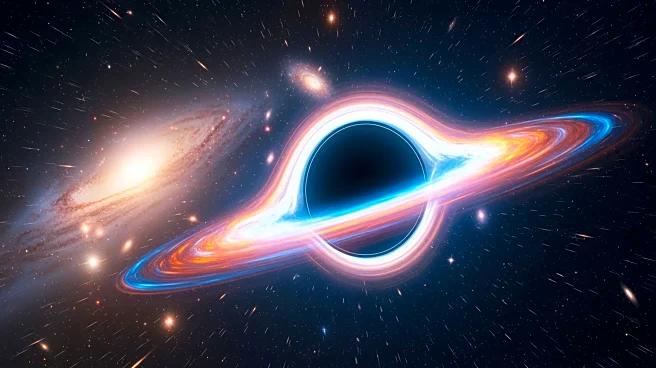
Astronomers using the James Webb Space Telescope (JWST) have confirmed the existence of the first known runaway supermassive black hole. This black hole, with a mass approximately 10 million times that
of the sun, is moving at about 1,000 kilometers per second, fast enough to escape its host galaxy. Located in the Cosmic Owl system, the black hole is dragging a stream of gas behind it, where new stars are forming. The discovery supports theories about black hole ejection during galaxy mergers and provides a new method for identifying such phenomena in space.
Why It's Important?
This discovery is significant for understanding galaxy evolution and the dynamics of supermassive black holes. The ability to confirm and study runaway black holes offers insights into the processes that can eject these massive objects from galaxies. It also highlights the capabilities of the JWST in advancing astronomical research. The findings could lead to further discoveries of similar phenomena, enhancing our knowledge of the universe's structure and the role of black holes in shaping galaxies.
What's Next?
Future missions, such as the Roman Space Telescope and Euclid, may use the methods developed from this discovery to locate more runaway black holes. These missions could provide a broader understanding of the frequency and impact of such events in the universe. Continued observations and research will likely focus on the implications of these findings for galaxy formation and the potential interactions between runaway black holes and other cosmic structures.