




What's Happening?
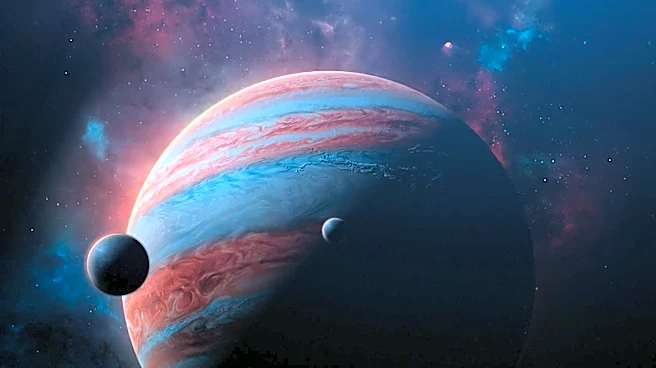
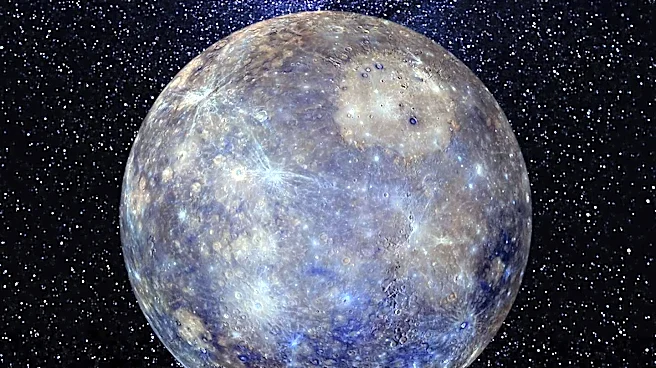
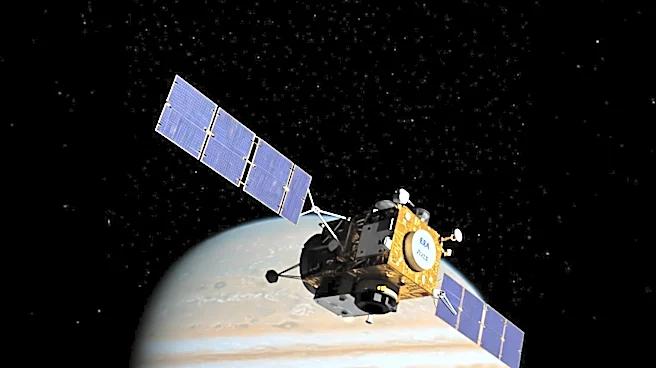
The European Space Agency's Jupiter Icy Moons Explorer (JUICE) mission, launched in April 2023, is set to explore Ganymede, the largest moon in the Solar System. Ganymede, which is larger than the planet Mercury, is believed to contain an immense layer
of water and ice, potentially exceeding all the water on Earth's surface. The moon also generates its own magnetic field, a unique feature among moons. JUICE is scheduled to reach Jupiter in July 2031 and will orbit Ganymede in December 2034, marking the first time a spacecraft will orbit a moon beyond Earth's own. The mission aims to study Ganymede's icy shell, magnetic field, and internal structure to better understand its composition and the potential for water beneath its surface.
Why It's Important?
The JUICE mission is significant as it could provide insights into the potential habitability of moons in the Solar System. Ganymede's vast water reserves and magnetic field make it an intriguing subject for understanding planetary formation and the conditions necessary for life. The mission's findings could impact our understanding of other celestial bodies with similar characteristics, influencing future space exploration and the search for extraterrestrial life. Additionally, the mission highlights the importance of international collaboration in advancing space science and technology.
What's Next?
Following its arrival at Jupiter in 2031, JUICE will conduct a detailed study of the Jovian system before entering orbit around Ganymede in 2034. The mission will employ radar, magnetic measurements, and other instruments to analyze the moon's surface and subsurface. These observations will help determine the thickness of Ganymede's ice, the arrangement of its water, and the dynamics of its magnetic field. The data collected could lead to new discoveries about the moon's geological history and its potential to support life.
Beyond the Headlines
Ganymede's exploration by JUICE could redefine our understanding of what constitutes a 'moon' versus a 'planet.' Despite being classified as a moon due to its orbit around Jupiter, Ganymede's size, water content, and magnetic field suggest it has planet-like qualities. This mission may challenge existing definitions and prompt discussions about the classification of celestial bodies. Furthermore, the study of Ganymede's magnetic field could provide insights into the processes that sustain magnetic fields in other planetary bodies, including Earth.