


What's Happening?
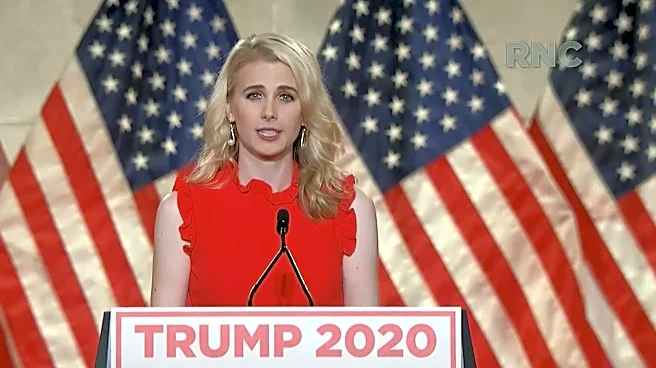
The White House has issued a strong rebuke against comedian Rosie O'Donnell, labeling her a 'total slob' after she made jokes on late-night television concerning Natalie Harp, President Trump's executive assistant. During her guest-hosting stint on 'Jimmy
Kimmel Live!', O'Donnell quipped that Harp tucks President Trump into bed at night. This comment comes amidst increased media scrutiny regarding Harp's proximity to the President. O'Donnell's remarks are part of a series of jabs she has directed at President Trump throughout her week-long guest-hosting role, including referring to him as 'Mango Mussolini' and performing a satirical rendition of 'Danny Boy' aimed at his political standing. The feud between O'Donnell and President Trump dates back to 2006 and intensified during his 2015 presidential campaign.
Why It's Important?
This incident highlights the ongoing and often contentious relationship between political figures and entertainment personalities, particularly in the context of late-night comedy. The White House's direct and personal attack on O'Donnell underscores the heightened political polarization and the readiness of political administrations to engage directly with critics from the entertainment industry. This exchange can influence public perception of both the comedian and the administration, potentially galvanizing supporters on both sides. It also raises questions about the boundaries of political humor and the appropriate responses from official government channels, reflecting a broader trend where political discourse frequently spills into popular culture and vice versa. The sustained nature of the feud between O'Donnell and President Trump demonstrates how personal rivalries can become intertwined with national political narratives.
What's Next?
Given the history between Rosie O'Donnell and President Trump, further exchanges or reactions are possible, though President Trump has not yet responded to O'Donnell's latest comments on Truth Social. Media outlets and political commentators are likely to continue discussing the incident, analyzing the implications of the White House's statement and O'Donnell's comedic approach. The event may also prompt further debate about the role of satire in political commentary and the nature of public discourse in a highly polarized environment. Future late-night comedy segments may draw inspiration from this interaction, potentially leading to more direct engagement between entertainers and political figures. The public will likely continue to see this dynamic play out in various forms of media.
Beyond the Headlines
The exchange between Rosie O'Donnell and the White House delves into deeper implications concerning freedom of speech, the weaponization of language in political discourse, and the evolving role of celebrity in shaping public opinion. The White House's use of strong, personal insults against a comedian can be seen as an attempt to delegitimize criticism and control narratives, potentially chilling free expression. Conversely, O'Donnell's persistent comedic attacks, while protected under free speech, contribute to a culture of political entertainment that can sometimes overshadow substantive policy discussions. This dynamic reflects a broader societal shift where the lines between entertainment, news, and political commentary are increasingly blurred, impacting how citizens consume information and form opinions about their leaders and national issues. It also highlights the power of social media and traditional media in amplifying these exchanges, making them central to public conversation.