







What's Happening?
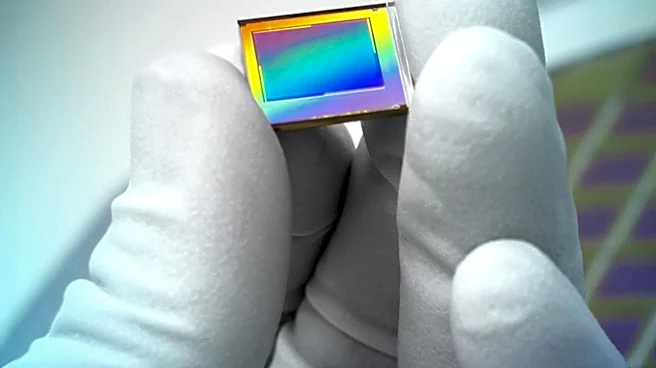
Researchers have developed a compact, compass-like metasurface that can directly visualize the optical spectrum and polarization of light. This innovative device, detailed in Science Advances, encodes wavelength into radial position and linear-polarization
orientation into azimuthal angle on a single metasurface. Unlike traditional methods that require separate optical components and extensive data processing, this new approach allows for the direct reading of light properties from a spatial pattern. The device is constructed from amorphous-silicon split-ring resonators on a silica substrate, each featuring a small notch that makes its resonant response sensitive to incident linear polarization. By varying the geometry radially and rotating the notch orientation azimuthally, the device creates a continuous mapping of wavelength to radius and polarization to angle. This allows for simultaneous measurement of intensity, linear-polarization orientation, and wavelength from a single image, eliminating the need for iterative computational reconstruction.
Why It's Important?
This development is significant for advancing optical instrumentation by simplifying the measurement of complex light properties. The ability to visualize wavelength and polarization directly on a single chip could lead to more compact and efficient optical systems. This integrated approach reduces the need for multiple components, complex calibration, and computational reconstruction, potentially lowering costs and increasing the speed of optical analysis. Such technology could be crucial for applications requiring precise light characterization, such as in material science for distinguishing materials or surface conditions that appear similar in ordinary intensity images. Furthermore, the concept of encoding multiple light properties into spatial coordinates on a single element opens doors for future advancements in multidimensional imaging and sensing, potentially impacting fields from telecommunications to medical diagnostics.
What's Next?
The researchers plan to extend the concept by adding chiral or spin-sensitive elements to enable discrimination of circular-polarization handedness, moving towards full-Stokes measurements. Improvements in resonator design and integration of the metasurface with compact optics or focal-plane detector arrays are also envisioned to support smaller and more parallel measurement systems. While the current demonstration is a scanning-based proof of concept, future work aims to enable real-time imaging. The broader goal is to shift how optical information is presented, making wavelength and polarization directly readable positions in an image, which could lead to more intuitive and efficient optical instruments. This ongoing research could pave the way for next-generation compact optical devices capable of comprehensive light analysis.
Beyond the Headlines
The core innovation lies in changing the paradigm of optical measurement from data processing to direct spatial encoding. This shift could democratize access to advanced optical analysis by making it more accessible and less computationally intensive. The ability to directly visualize complex light properties could foster new discoveries in fields where light-matter interactions are critical, such as quantum optics and advanced materials research. Ethically, more accessible and powerful optical sensing could enhance capabilities in areas like environmental monitoring and quality control, offering more detailed insights into various phenomena. Long-term, this technology could contribute to the development of highly integrated photonic circuits, enabling new forms of on-chip sensing and communication that are currently limited by the complexity and size of traditional optical setups.