
What's Happening?
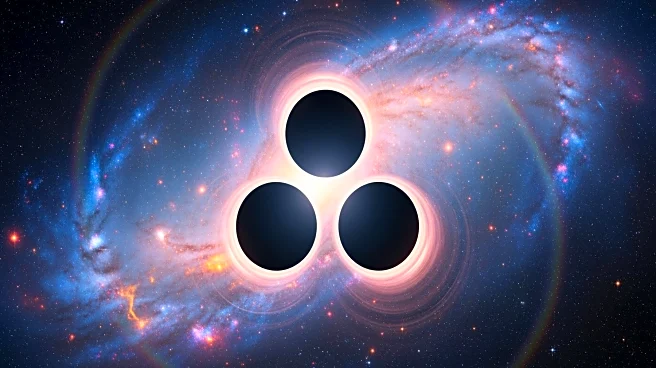
Astronomers have identified a rare cosmic event involving three supermassive black holes on a collision course within a merging system of galaxies named J1218/1219+1035, located 1.2 billion light-years from Earth. Each galaxy in the merger hosts an active
galactic nucleus (AGN), emitting radio light as they consume material. This discovery, made using data from the Wide-field Infrared Survey Explorer, marks the first time all three AGNs in such a system have been observed in radio light, providing a unique opportunity to study the growth of massive galaxies and their black holes.
Why It's Important?
The discovery of this triple AGN system offers a rare opportunity to study the dynamics of galaxy mergers and the growth of supermassive black holes. Understanding these processes is crucial for astrophysics, as galaxy mergers are a primary mechanism for galaxy and black hole growth. The findings could lead to new insights into the life cycles of galaxies and the role of black holes in cosmic evolution, potentially influencing future research and theoretical models.
What's Next?
Astronomers plan to conduct follow-up observations across multiple wavelengths to gain a deeper understanding of the triple AGN system. These studies aim to uncover more about the interactions between the galaxies and their black holes, potentially revealing new information about the processes driving galaxy and black hole evolution. The research could also help identify other similar systems, enhancing our knowledge of the universe's complex structures.