
What's Happening?
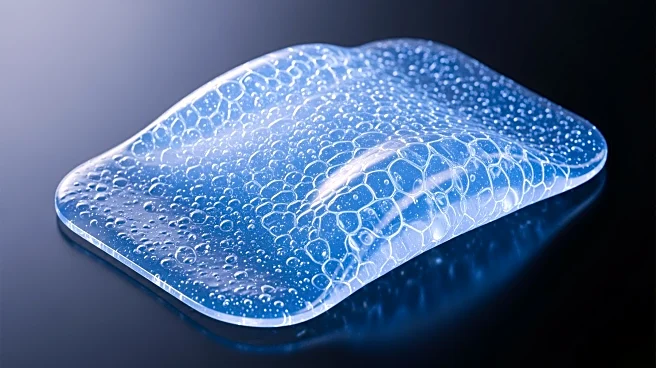
Researchers from Hunan University have developed a skin-inspired hydrogel capable of self-powered strain sensing underwater and in extreme cold. This hydrogel, named PLTAV, mimics the cellular organization
of epithelial tissue, achieving high compressibility and low energy loss. It generates its own voltage to sense strain without batteries, making it ideal for wearable sensors. The hydrogel can stretch significantly and recover its shape, maintaining properties through numerous cycles. An enhanced version, PLTAV-SC, remains flexible at temperatures as low as -45°C and functions underwater, detecting motion and water flow.
Why It's Important?
The development of this hydrogel represents a breakthrough in material science, offering a solution to the mechanical trade-offs that have limited the use of hydrogels in real-world applications. Its ability to function in extreme conditions and generate voltage without external power sources makes it valuable for wearable devices, underwater monitoring systems, and human-machine interfaces. This innovation could lead to new applications in various fields, including healthcare, environmental monitoring, and robotics, where reliable and durable sensors are crucial.