



What's Happening?
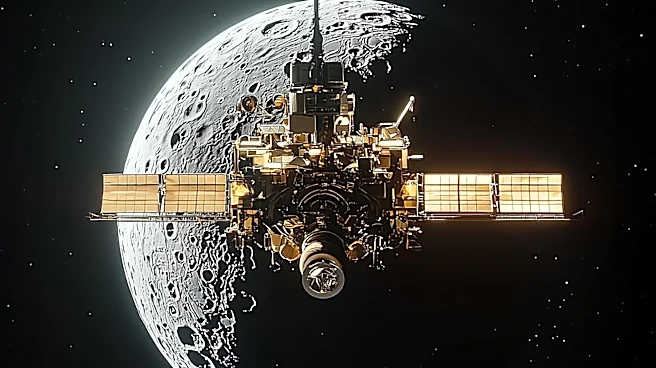
NASA has delivered the NavCube3-mini, a compact navigation receiver, to Intuitive Machines for integration into the Altus-1 lunar relay satellite. This marks a significant step in developing future lunar communications and navigation services. The NavCube3-mini, about
half the size of a shoebox, uses signals from Earth-based GPS and Galileo systems to determine precise positions in lunar orbit. It underwent extensive testing at NASA's Goddard Space Flight Center to ensure its readiness for spaceflight. The payload will support NASA's vision for sustained human presence on the Moon by providing reliable navigation and communication services.
Why It's Important?
The deployment of the NavCube3-mini is crucial for supporting future lunar missions, including NASA's Artemis program, which aims to land astronauts on the Moon by 2028. Reliable navigation and communication are essential for the safety and success of these missions, particularly in challenging regions like the lunar South Pole. The technology also represents a significant advancement in extending GPS capabilities beyond Earth, paving the way for more autonomous and efficient lunar exploration. This development is part of NASA's broader strategy to collaborate with commercial partners and build a robust lunar infrastructure.
What's Next?
The integration of NavCube3-mini into the Altus-1 satellite is a key milestone in establishing a network of lunar relay satellites. These satellites will provide continuous communication and navigation support for various lunar missions, including orbiters, landers, and rovers. As NASA continues to develop its lunar exploration capabilities, further advancements in navigation technology are expected. This includes enhancing the precision and reliability of navigation systems to support more complex and ambitious missions on the lunar surface.