



What's Happening?
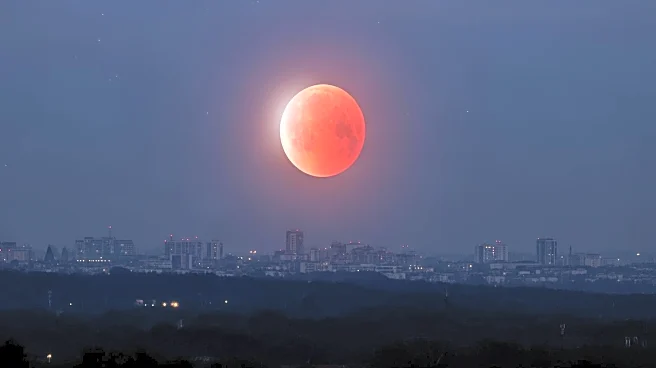
A total lunar eclipse, known as the Blood Moon, is set to occur on March 3, 2026, and will be visible from New York. This celestial event marks the last total lunar eclipse for the next two years. During the eclipse, the Earth will move between the sun
and the full moon, casting a shadow that gives the moon a dark red or orange hue. The eclipse will begin at 3:44 a.m. Eastern Standard Time, with the totality phase starting at 6:04 a.m. and peaking at 6:33 a.m. The event will conclude at 7:02 a.m. However, due to the moon's low position in the sky, it may fade from view before setting. New Yorkers are advised to find a clear line of sight to the moon, preferably in a dark environment away from city lights, to fully enjoy the spectacle.
Why It's Important?
The total lunar eclipse offers a unique opportunity for skywatchers and astronomy enthusiasts in New York to witness a rare celestial event. Unlike solar eclipses, lunar eclipses can be viewed safely with the naked eye, making them accessible to a wider audience. This event also serves as an educational moment, highlighting the dynamics of celestial bodies and their interactions. The Blood Moon phenomenon, with its striking red hue, captivates public interest and fosters a greater appreciation for astronomy. Additionally, such events can boost local tourism as enthusiasts travel to optimal viewing locations, potentially benefiting local economies.
What's Next?
Following the March 3, 2026, eclipse, the next total lunar eclipse will not occur until 2028. This gap underscores the rarity of such events and may increase public interest and participation in future astronomical occurrences. In the meantime, educational institutions and astronomy clubs may organize events and workshops to engage the public and promote interest in space science. The anticipation of future eclipses could also lead to advancements in observational technology and techniques, enhancing the experience for both amateur and professional astronomers.