



What's Happening?
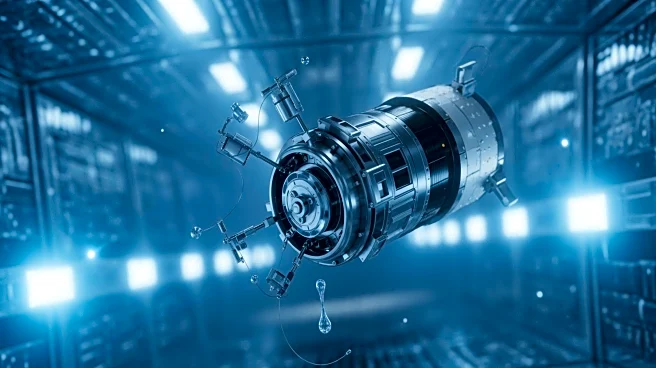
NASA is conducting a microgravity experiment aboard the International Space Station (ISS) to study the behavior of particles in a viscous fluid. The experiment, known as the Fluid Particles experiment, involves tiny ball bearings surrounding a larger
central bearing within the Microgravity Science Glovebox (MSG) in the ISS's Destiny laboratory module. By subjecting the particles to oscillating frequencies, researchers aim to observe how they cluster and form larger structures in microgravity. The insights gained from this research could have significant applications in space, such as improving fire suppression, mitigating lunar dust, and enhancing plant growth. On Earth, the findings may contribute to a better understanding of pollen dispersion, algae blooms, plastic pollution, and sea salt transport during storms. This research is also expected to inform long-duration space missions, including NASA's Artemis program and future human expeditions to Mars.
Why It's Important?
The microgravity experiment conducted by NASA is crucial for advancing both space exploration and terrestrial applications. In space, understanding particle behavior in microgravity can lead to improved technologies for fire suppression and dust mitigation, which are critical for the safety and success of long-duration missions. Additionally, enhancing plant growth in space is vital for sustaining human life during extended missions to the Moon and Mars. On Earth, the research could provide valuable insights into environmental phenomena such as pollen dispersion and algae blooms, which have significant ecological and economic impacts. By improving our understanding of these processes, the experiment could lead to better environmental management and pollution control strategies.