








What's Happening?
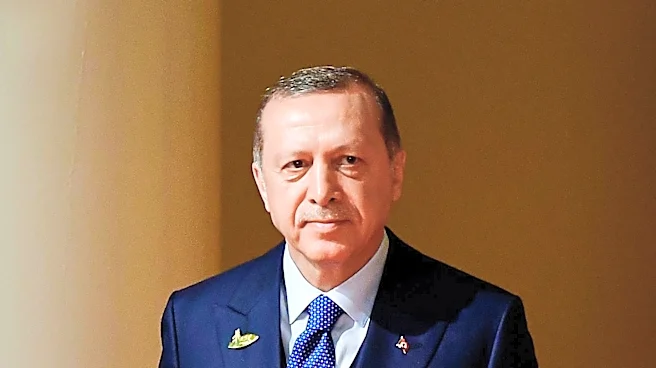
Turkish President Recep Tayyip Erdogan is scheduled to visit South Korea from November 1-4, 2026, at the invitation of South Korean President Lee Jae Myung. The visit aims to strengthen the strategic partnership between the two nations and will include
bilateral talks on November 3. Discussions are expected to cover a wide range of topics, including trade, investment, defense, and technology cooperation. Both countries are targeting a bilateral trade volume of $15 billion, building on the $8.7 billion achieved in the first nine months of 2026. This marks President Erdogan's first visit to South Korea in eight years, and several agreements are anticipated to be signed to enhance the legal framework of their bilateral relations. The leaders last met during the NATO summit in Ankara in July 2026.
Why It's Important?
This visit is significant for both Turkey and South Korea as they seek to deepen economic and strategic ties amid evolving global dynamics. For Turkey, the visit aligns with its 'Far Countries Strategy,' which aims to diversify international economic partnerships and expand trade with high-potential markets. South Korea's advanced technological capabilities and investment potential are crucial for Turkey's development goals, particularly in areas like nuclear energy, artificial intelligence, semiconductors, and defense. For South Korea, strengthening relations with Turkey, a strategically located NATO member, offers opportunities to expand its influence and market access in the Eurasian region. The focus on balancing trade, which currently heavily favors South Korea, is also a key aspect, as Turkey seeks to increase its exports, particularly in pharmaceuticals and machinery. Enhanced cooperation in defense and technology could also lead to joint ventures and shared advancements, benefiting both nations' industrial bases.
What's Next?
During the visit, President Erdogan and President Lee Jae Myung are expected to sign various documents to solidify their bilateral relations. The discussions will likely lead to concrete steps in expanding cooperation in energy, defense, transportation, infrastructure, high technology, culture, and tourism. Both countries will continue to work towards their ambitious $15 billion bilateral trade target. Further engagement in strategic industries such as nuclear energy, where South Korea's Korea Electric Power Corp. (KEPCO) has been involved in feasibility studies for Turkey's Sinop nuclear power plant project, is anticipated. The visit will also serve as a precursor to the 70th anniversary of diplomatic relations between Turkey and South Korea in 2027, setting the stage for future collaborations and a stronger strategic partnership.
Beyond the Headlines
The deepening of the Turkey-South Korea strategic partnership extends beyond immediate economic and defense gains. It reflects a broader trend of middle powers seeking to forge stronger alliances and diversify their international engagements in a multipolar world. For Turkey, this move helps reduce its reliance on traditional partners and enhances its geopolitical standing by connecting with a key Asian economic and technological powerhouse. For South Korea, it provides a gateway to European and Middle Eastern markets and strengthens its position as a global technology and defense exporter. The emphasis on high-tech cooperation, including AI and semiconductors, suggests a long-term vision for co-innovation and shared technological leadership, potentially influencing global supply chains and technological standards. This strategic alignment could also serve as a model for other nations looking to build resilient and diversified international partnerships.