


What's Happening?
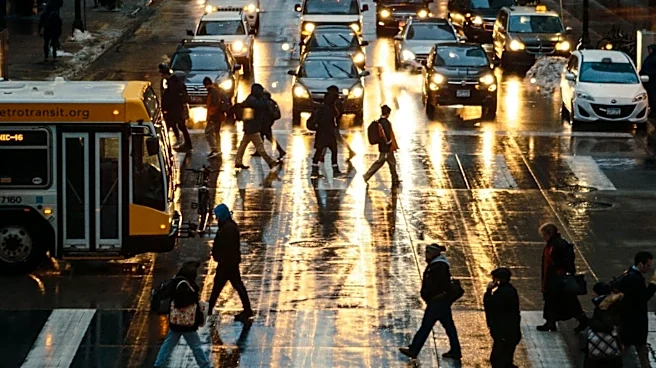
Milwaukee's West Burleigh Street is facing renewed scrutiny regarding pedestrian safety following two fatal accidents within seven months, occurring just one block apart. The latest victim, 36-year-old Patrick McGowan, was struck and killed near North
49th and West Burleigh streets. Seven months prior, 73-year-old Henry "Happy" Goodlow was killed near North 48th Street. Both incidents involved pedestrians being struck by vehicles, and both occurred after dark. Residents and city officials, including Jessica Wineberg, Milwaukee's Vision Zero policy director, acknowledge that this stretch of Burleigh Street is part of the city's High Injury Network, an area with a disproportionately high number of serious and deadly crashes.
Why It's Important?
The recurring fatal accidents on Burleigh Street underscore a critical urban planning and public safety challenge in Milwaukee. The designation of this area as a 'High Injury Network' highlights systemic issues in road design and traffic management that contribute to pedestrian vulnerability. The incidents raise urgent questions about the effectiveness and pace of current safety improvement initiatives. For residents, the fear of crossing the street becomes a daily reality, impacting their quality of life and access to essential services like the nearby hospital, schools, and businesses. Economically, such unsafe conditions can deter local commerce and investment, as businesses and potential residents may avoid areas perceived as dangerous.
What's Next?
While an active traffic safety construction project is underway a few blocks west at North 51st Street and West Burleigh Street, which includes accessible curb ramps and curb extensions, there are currently no specific additional improvement projects planned for the immediate locations of the recent fatalities. Milwaukee's Vision Zero policy director, Jessica Wineberg, indicated that the city analyzes crash patterns to prioritize projects, but major street reconstruction can take years due to resource limitations and planning processes. The city is exploring options like raised crosswalks, raised intersections, additional traffic calming measures, and center medians. Drivers are urged to slow down, and the city is advocating for changes in state law to allow speed and red-light safety cameras.
Beyond the Headlines
The tragic deaths on Burleigh Street expose a deeper societal issue regarding urban infrastructure and its impact on vulnerable populations, particularly pedestrians and those with mobility devices. The slow pace of implementing safety improvements, even in identified high-risk areas, reflects the complex interplay of funding, bureaucratic processes, and political will. This situation highlights the ethical imperative for cities to prioritize human life over traffic flow efficiency, especially in areas with mixed-use developments and high pedestrian activity. The call for drivers to slow down, while crucial, also points to the need for systemic changes that engineer safer behaviors rather than solely relying on individual responsibility. The long-term implication is a potential shift towards more pedestrian-centric urban design and policy, driven by community advocacy and a re-evaluation of how cities measure and address road safety.