






What's Happening?
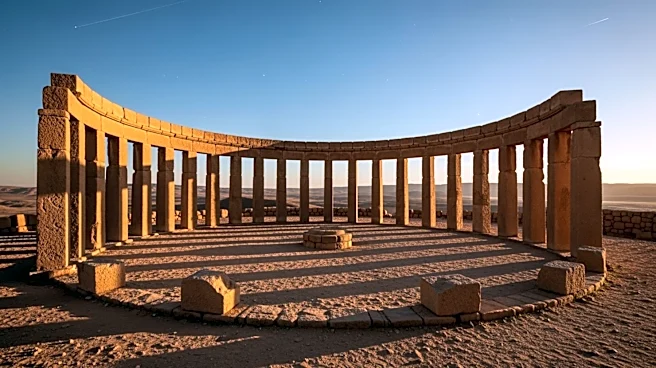
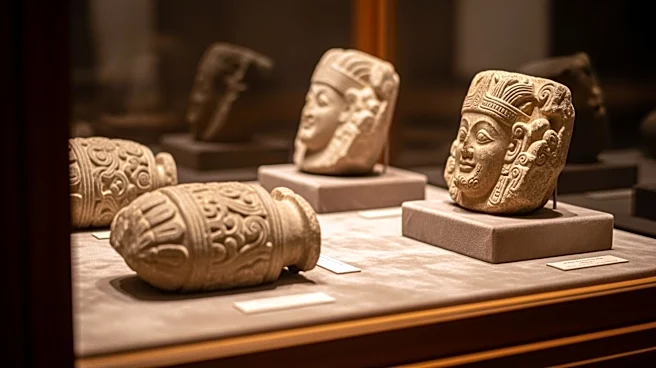
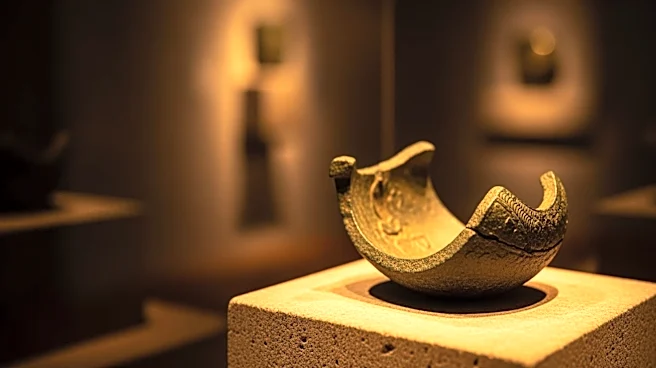
The Legion of Honor in San Francisco is hosting an exhibition titled 'The Etruscans: From the Heart of Ancient Italy,' showcasing nearly 200 objects from the ancient Etruscan civilization. This exhibition aims to shed light on the Etruscans, who thrived
in central Italy for approximately 800 years until the first century BC. Known for their rich trade networks and cultural achievements, the Etruscans left behind a legacy of impressive temples, homes, and artifacts. The exhibition features significant items such as the third-century BC Liber Linteus Zagrabiensis, the longest surviving Etruscan text, and grave objects from the Regolini-Galassi Tomb. Curator Renée Dreyfus emphasizes the exhibition's goal to correct historical misconceptions and highlight the Etruscans' influence on Roman culture, including innovations in hydraulic systems and city planning.
Why It's Important?
This exhibition is significant as it provides a deeper understanding of the Etruscan civilization, which has often been overshadowed by the Romans and Greeks. By showcasing artifacts and recent archaeological discoveries, the exhibition offers insights into Etruscan social structures, beliefs, and their lasting impact on Roman culture. The event also highlights the importance of preserving and studying ancient cultures to understand their contributions to modern society. For historians and archaeologists, this exhibition presents an opportunity to explore the complexities of Etruscan language and culture, which have been challenging to decipher due to the scarcity of written records.
What's Next?
The exhibition is expected to run from May 2 to September 20, providing ample time for scholars, students, and the general public to engage with the Etruscan artifacts. The event may inspire further research and interest in Etruscan studies, potentially leading to new archaeological expeditions and discoveries. Additionally, the exhibition could encourage other museums to explore and display lesser-known ancient civilizations, broadening the scope of historical education and appreciation.
Beyond the Headlines
The exhibition not only highlights the Etruscans' historical significance but also raises questions about cultural assimilation and preservation. The Etruscans' ability to adapt and influence Roman practices suggests a complex interplay between conquered and conquering cultures. This narrative challenges the simplistic view of cultural erasure and invites a reevaluation of how ancient societies interacted and evolved. The exhibition also underscores the importance of interdisciplinary collaboration in uncovering and interpreting ancient histories, combining archaeology, linguistics, and art history.