
What's Happening?
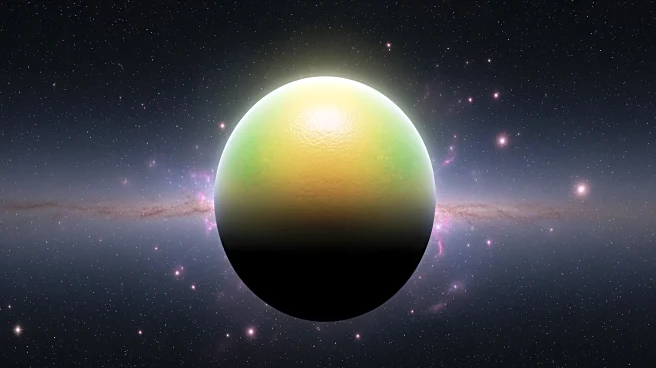
NASA's James Webb Space Telescope has made a significant observation of an exoplanet named PSR J2322-2650b, which exhibits a unique lemon shape due to its proximity to a pulsar. Discovered in 2017, this
exoplanet orbits the pulsar PSR J2322-2650, located 750 light-years from Earth. The pulsar emits electromagnetic waves at rapid intervals, which are only visible when directed towards Earth. The James Webb Space Telescope's infrared capabilities have allowed scientists to study the exoplanet's unusual atmospheric composition, which remains unexplained. The pulsar's rapid rotation, approximately 300 times per second, emits high-energy particles, but these do not interfere with the telescope's observations. This allows for detailed study of the exoplanet, which is illuminated by the pulsar's emissions while the pulsar itself remains invisible.
Why It's Important?
The observation of PSR J2322-2650b by the James Webb Space Telescope is crucial for understanding the formation and characteristics of exoplanets in extreme environments. The exoplanet's unusual shape and atmospheric composition challenge existing theories about planetary formation and behavior in the vicinity of pulsars. This discovery could lead to new insights into the gravitational effects exerted by pulsars on nearby celestial bodies. Additionally, the ability to observe such phenomena enhances the scientific community's understanding of the universe's diversity and complexity. The findings may influence future research directions and the development of new models to explain planetary dynamics in similar systems.
What's Next?
Further studies are expected to focus on the detailed analysis of PSR J2322-2650b's atmospheric composition and its interaction with the pulsar's emissions. Researchers may use additional observations from the James Webb Space Telescope and other instruments to gather more data on the exoplanet's characteristics. These efforts aim to unravel the mysteries of its formation and the forces shaping its unique structure. The scientific community will likely explore the implications of these findings for other exoplanetary systems, potentially leading to broader discoveries about the universe's formation and evolution.