
What's Happening?
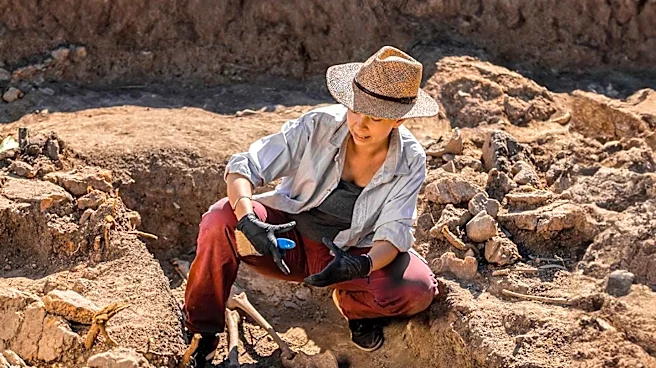
Archaeologists excavating at the Roman fort of Magna, near Hadrian's Wall in northern England, have discovered several pairs of well-preserved shoes. Among these finds, a small percentage are notably larger
than typical Roman footwear, measuring over 12 inches (30 centimeters) in length. The average size of the recovered shoes corresponds to a modern women's UK size 3.5-4 (EU 36-37), which aligns with the average European male height of 5 ft. 6 in. to 5 ft. 6½ in. (167–168 cm) during that era. However, some outliers are equivalent to a UK size 6.5-8 (EU 40-42), which is significantly larger than the standard. This discovery has sparked curiosity among experts regarding the potential reasons behind these unusually large shoes. Previous archaeological findings include a Roman skeleton over 6 ft. 6 in. (2 meters) tall, though such discoveries are rare anomalies.
Why It's Important?
This discovery offers a unique glimpse into the daily lives and challenges faced by Roman soldiers stationed at the northern frontier of their empire. The presence of unusually large shoes could indicate several possibilities, each with significant implications for understanding Roman military life and adaptation. If these shoes belonged to exceptionally tall individuals, it challenges common perceptions of Roman physical stature and suggests a greater diversity in the population than previously assumed. Alternatively, the theory that soldiers wore socks and undergarments within these larger shoes highlights the practical measures taken to combat the harsh British climate, underscoring the ingenuity and resilience of Roman legions. The medical or orthopedic function hypothesis suggests a focus on soldier welfare, indicating that even in ancient times, provisions were made to alleviate discomfort from strenuous activities like long marches or prolonged exposure to cold and wet conditions. This insight enriches our understanding of Roman logistics, health practices, and the human element of their military campaigns.
What's Next?
Further archaeological digs are planned around Hadrian's Wall in the coming months. These future excavations aim to uncover more artifacts and potentially human remains that could shed light on the individuals who wore these large shoes. Researchers hope to determine whether these shoes were indeed made for unusually tall people or if they served a more practical purpose, such as accommodating extra layers for warmth or providing orthopedic support. The ongoing research will involve detailed analysis of any new findings, potentially including skeletal remains, to correlate shoe size with individual stature. Additionally, comparative studies with other Roman military sites might provide broader context on footwear variations across the empire. The findings from these future investigations are expected to either confirm existing theories or introduce new hypotheses regarding Roman life and military practices at the edge of their dominion.
Beyond the Headlines
The mystery of the large Roman shoes extends beyond mere historical curiosity, touching upon broader themes of human adaptation, cultural practices, and the interpretation of archaeological evidence. The debate over whether these shoes signify exceptionally tall individuals or practical solutions to environmental challenges highlights the complexities of reconstructing ancient life from material culture. It prompts reflection on how modern biases about average human size might influence our understanding of historical populations. Furthermore, the potential medical or orthopedic use of these shoes underscores the timeless human need to mitigate physical discomfort and adapt to challenging environments, whether through simple layering or specialized footwear. This discovery encourages a nuanced view of Roman society, moving beyond idealized images of soldiers to appreciate their pragmatic approaches to survival and well-being in a demanding frontier setting. It also serves as a reminder that archaeological finds often raise more questions than answers, driving continuous inquiry and re-evaluation of historical narratives.