

What's Happening?
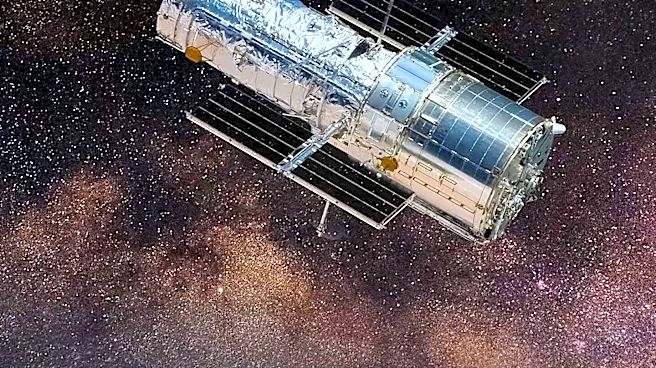
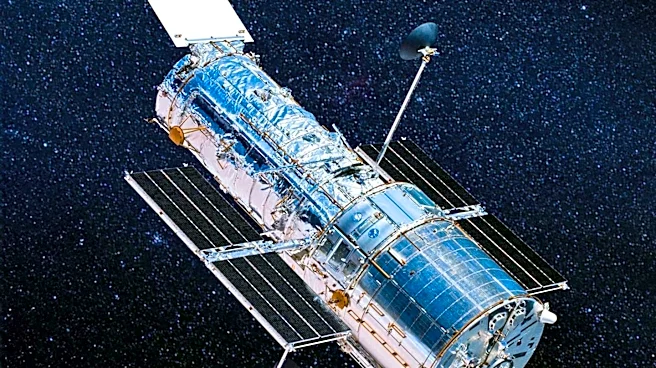
NASA's Hubble Space Telescope and the newly launched Nancy Grace Roman Space Telescope are collaborating to study gravitational lensing, a phenomenon where massive objects bend and magnify light from distant galaxies. Hubble has captured a diverse gallery
of gravitational lenses, which will serve as targets for follow-up observations by Roman. Gravitational lensing allows astronomers to view objects much farther away and helps in understanding the distribution of mass, including invisible dark matter, in foreground galaxies. While Hubble provides high-resolution views in visible and ultraviolet light, Roman, primarily observing in infrared, offers a much wider field of view, enabling it to capture more lenses. This collaborative approach aims to build a comprehensive picture of the cosmos and test theories about dark matter.
Why It's Important?
This collaboration is crucial for advancing our understanding of the universe, particularly regarding dark matter, which constitutes a significant portion of the cosmos but remains largely mysterious. By combining Hubble's detailed imaging with Roman's wide-field infrared capabilities, astronomers can gather a more extensive and varied dataset of gravitational lenses. This data will be used to construct lens models that help determine the mass distribution in foreground galaxies, potentially confirming or challenging the cold dark matter theory. The ability to detect small imperfections in lensed galaxy arcs could provide evidence for small clumps of dark matter, offering critical insights into its nature. Such discoveries have profound implications for fundamental physics and cosmology, shaping our understanding of how galaxies evolve and the overall structure of the universe.
What's Next?
Astronomers will use the detailed Hubble images to develop a 'super-intelligence tool' to efficiently search for similar arcs in the upcoming Roman images. This tool will enable the analysis of Roman's larger sample of lenses, which is expected to yield significant results on dark matter. The combined observations from both telescopes will allow researchers to explore differences in lensed galaxies, such as the presence of young (bluish) versus older (reddish) stars, to better understand galaxy evolution in the early universe. The collaboration will also investigate unique lens characteristics, like Einstein Rings and quadruply lensed galaxies, to refine models of mass distribution. This ongoing research will contribute to the 2030 Astrophysics Decadal Survey, informing future space missions and scientific priorities.
Beyond the Headlines
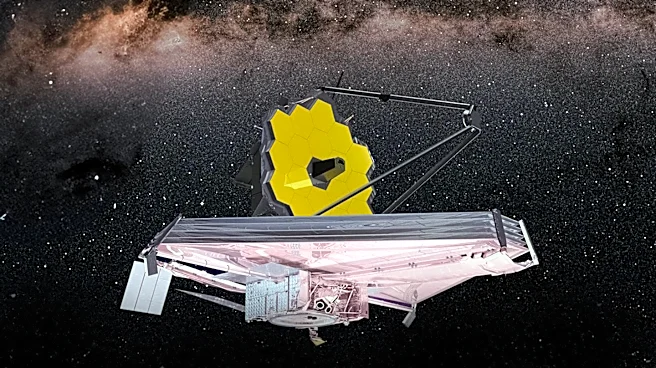
The synergistic use of Hubble and Roman telescopes represents a powerful approach in modern astrophysics, demonstrating how different observational capabilities can complement each other to achieve scientific breakthroughs. This collaborative model extends beyond these two telescopes, involving other Great Observatories like the Chandra X-ray Observatory and the James Webb Space Telescope, creating a multi-wavelength view of the universe. The quest to understand dark matter is one of the most profound challenges in science, with potential implications for our understanding of gravity, the fundamental forces of nature, and the ultimate fate of the universe. The ethical implications of such discoveries often revolve around the human pursuit of knowledge and our place in the cosmos, while the technological advancements required for these telescopes push the boundaries of engineering and data analysis, benefiting various fields beyond astronomy.