


What's Happening?
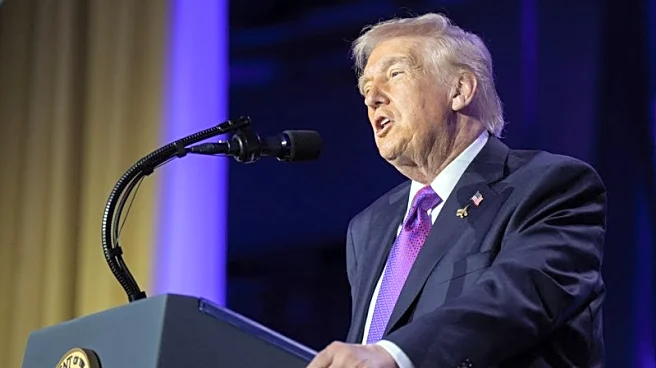
President Trump has signed an executive order directing the Department of Justice to challenge state laws regulating artificial intelligence (AI). This move aims to replace the diverse state regulations with a unified federal standard, arguing that AI,
as a national economic and defense asset, requires consistent oversight. The administration has established an 'AI Litigation Task Force' to address what it describes as a 'patchwork of 50 State Regulatory Regimes.' Critics argue that this approach could stifle innovation by imposing a single standard, while supporters believe it will eliminate the complexity of navigating multiple state laws. The order has sparked a debate about the balance between federal and state powers in regulating emerging technologies.
Why It's Important?
The executive order has significant implications for the tech industry and state governments. By seeking to centralize AI regulation, the federal government aims to streamline compliance for businesses operating across state lines. However, this move could undermine state efforts to address local concerns and protect consumers. The order reflects broader tensions between federal authority and state autonomy, particularly in areas where technology rapidly evolves. For businesses, a single federal standard could reduce compliance costs and legal uncertainties, but it may also limit the ability to adapt to specific state needs. The outcome of this initiative could set a precedent for how emerging technologies are regulated in the U.S.
What's Next?
The Department of Justice is expected to begin legal challenges against state AI regulations, which could lead to a series of court battles. These cases will likely test the limits of federal preemption and state rights. Meanwhile, Congress may be prompted to consider comprehensive AI legislation to provide clearer guidance. Businesses and legal experts will closely monitor these developments to understand the evolving regulatory landscape. The outcome could influence future federal-state dynamics in technology regulation and impact how other emerging technologies are governed.
Beyond the Headlines
The executive order raises questions about the role of states as 'laboratories of democracy' in experimenting with AI regulations. State-level initiatives have been crucial in addressing specific local issues and fostering innovation. The federal push for a unified standard may limit these experiments, potentially stifling diverse approaches to AI governance. Additionally, the order highlights the challenge of balancing innovation with consumer protection, as AI technologies pose unique risks and opportunities. The debate over federal versus state regulation of AI could have long-term implications for how the U.S. approaches technology policy and governance.