







What's Happening?
On April 18, 1861, Dr. Paul Broca, a French physician, conducted an autopsy on a patient known as 'Tan' at Bicêtre Hospital near Paris. The patient, Louis Victor Leborgne, had been unable to speak for over two decades, only able to utter the word 'tan.'
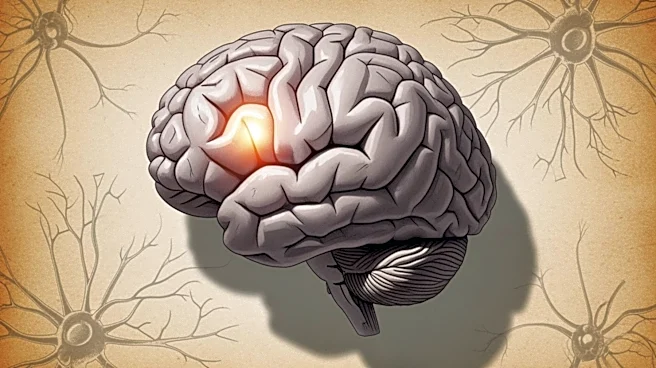
Broca's examination revealed a significant lesion in the left frontal lobe of the brain, which he associated with the patient's speech impairment. This discovery provided strong evidence for the localization of brain functions, challenging the prevailing belief that brain functions were diffused throughout the organ. Broca's findings were presented at the Anthropological Society Meeting in Paris, marking a pivotal moment in neuroscience by identifying what is now known as Broca's area, a region critical for speech production.
Why It's Important?
Broca's discovery was a landmark in the field of neuroscience, establishing the concept of localized brain functions. This finding laid the groundwork for modern neuroscience and our understanding of how specific brain regions are responsible for distinct cognitive functions. The identification of Broca's area has had profound implications for diagnosing and treating speech disorders, such as aphasia, where patients can understand language but struggle to produce it. This research has influenced therapeutic approaches, including speech therapy, which can help patients regain speech abilities. Broca's work continues to inform contemporary studies on brain function and language processing, highlighting the importance of targeted research in advancing medical science.
What's Next?
Following Broca's initial findings, further research into brain localization continued, leading to the identification of other critical areas, such as Wernicke's area, which is involved in language comprehension. Modern neuroscience has expanded on Broca's work, using advanced imaging techniques to map brain activity and understand the complex networks involved in speech and language. Ongoing research aims to develop more effective treatments for speech and language disorders, leveraging insights from Broca's pioneering work. The continued exploration of brain function localization promises to enhance our understanding of neurological conditions and improve therapeutic interventions.
Beyond the Headlines
Broca's discovery not only advanced scientific understanding but also challenged existing medical and philosophical beliefs about the brain and its functions. The notion of localized brain functions sparked debates and further research into the relationship between brain structure and behavior. This shift in perspective has influenced various fields, including psychology, cognitive science, and artificial intelligence, as researchers seek to replicate human cognitive processes in machines. Broca's work underscores the importance of empirical evidence in shaping scientific paradigms and continues to inspire interdisciplinary research into the mysteries of the human brain.