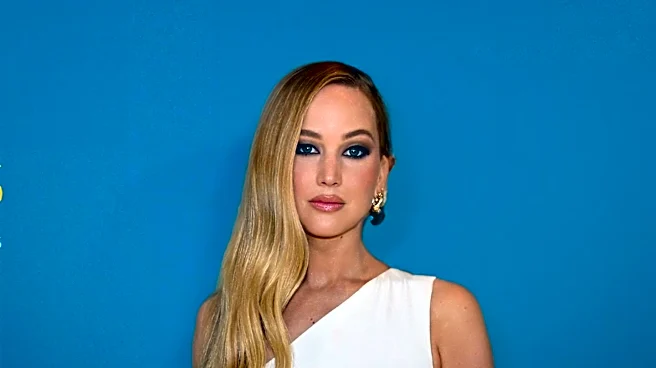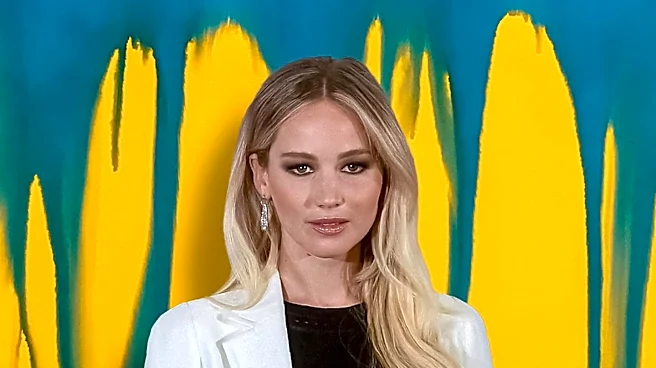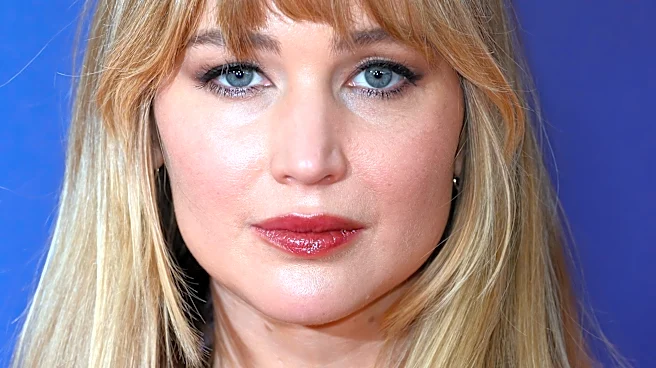










What's Happening?
Despite recurring online searches and comparison articles linking their names, there is no verified personal, family, or professional connection between actress Jennifer Lawrence and business executive Jim Taiclet. Jennifer Lawrence is an Academy Award-winning
actress and film producer, known for roles in 'The Hunger Games' and 'Silver Linings Playbook,' and is married to art gallery director Cooke Maroney. Jim Taiclet is the chairman, president, and CEO of Lockheed Martin, a major aerospace and defense company, and has a private family life. Their professional paths are distinct: Lawrence operates in the entertainment industry through her production company, Excellent Cadaver, while Taiclet leads a global aerospace and defense corporation. Online appearances of their names together are attributed to search engine algorithms and curiosity-driven content rather than any established relationship.
Why It's Important?
The persistent online speculation linking Jennifer Lawrence and Jim Taiclet, despite a lack of factual basis, underscores the challenges of misinformation and the impact of search engine algorithms on public perception. This phenomenon highlights how unrelated individuals can become inadvertently associated through online content, potentially leading to confusion and the spread of unverified claims. For public figures like Lawrence and Taiclet, such speculation can necessitate clarification and divert attention from their actual professional achievements. For the public, it emphasizes the importance of critically evaluating online information and relying on verified sources, such as official company biographies and reputable news outlets, to distinguish fact from speculation. This situation also reflects the broader issue of how digital information ecosystems can inadvertently create narratives that lack real-world foundation.
What's Next?
Given the nature of online search trends, it is likely that the names of Jennifer Lawrence and Jim Taiclet may continue to appear together in search results and comparison articles. Public figures and their teams may need to periodically address such recurring misinformation to maintain clarity regarding their personal and professional lives. For search engines and content platforms, this scenario highlights the ongoing challenge of refining algorithms to prioritize factual accuracy and context, thereby reducing the propagation of unverified associations. The incident serves as a reminder for both content creators and consumers to exercise diligence in information dissemination and consumption, respectively, to combat the spread of unfounded claims in the digital age.
Beyond the Headlines
This case delves into the deeper implications of digital information architecture and its influence on public perception. The 'why' behind their names appearing together online—rooted in search engine optimization and comparison articles—reveals how algorithms, designed to connect related content, can sometimes create spurious connections. This algorithmic behavior can inadvertently fuel celebrity gossip and unverified narratives, impacting the privacy and public image of individuals. It also raises questions about digital literacy and the responsibility of users to discern credible information from speculative content. The phenomenon illustrates a broader societal challenge in the digital era: distinguishing between algorithmic associations and genuine, verifiable relationships, and understanding how online 'buzz' can be generated without a factual basis.