
What's Happening?
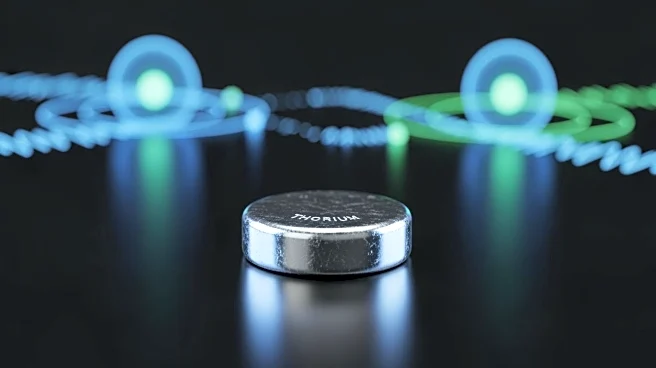
Researchers at UCLA have developed a new method to create nuclear clocks using a minimal amount of thorium, a rare isotope. This breakthrough was achieved by electroplating thorium onto steel, a technique
borrowed from jewelry making, which is more efficient than previous methods that required delicate crystals. The new approach uses significantly less thorium, making the production of nuclear clocks more feasible. These clocks are expected to be vastly more precise than current atomic clocks and could operate in environments where GPS fails, such as deep space or underwater. The research, supported by the National Science Foundation, involved collaboration with several international institutions.
Why It's Important?
The development of more efficient nuclear clocks has significant implications for various fields. These clocks could enhance navigation systems, especially in areas where GPS is unreliable, such as deep space and underwater environments. They also hold potential for improving communication networks, radar systems, and power grid synchronization. Furthermore, the precision of nuclear clocks could aid in fundamental physics research, including tests of Einstein's theory of relativity. The ability to produce these clocks more affordably and in smaller sizes could lead to widespread adoption in various industries, enhancing technological capabilities and national security.
What's Next?
The next steps involve further refining the electroplating technique to ensure the durability and reliability of the nuclear clocks. Researchers may also explore the integration of these clocks into existing systems, such as power grids and communication networks. Additionally, there is potential for collaboration with aerospace and defense industries to develop applications for these clocks in navigation and timing systems. The ongoing research could also lead to new discoveries in fundamental physics, as the precision of nuclear clocks allows for more accurate measurements and experiments.