






What's Happening?
Tyrannosaurus rex has been identified as the largest North American carnivore to have ever lived, reaching lengths of 40 feet and standing 13 feet tall at the hip. This formidable predator roamed the American Midwest during the Late Cretaceous period.
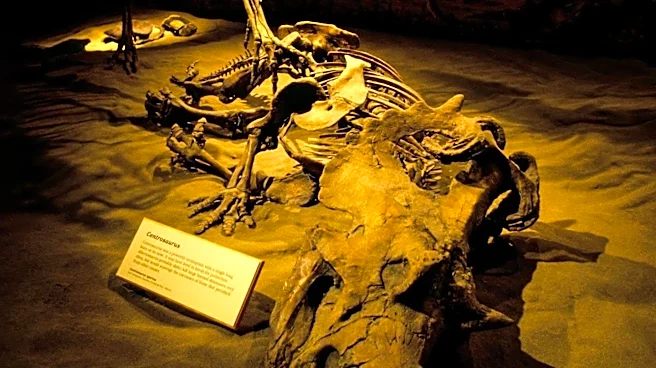
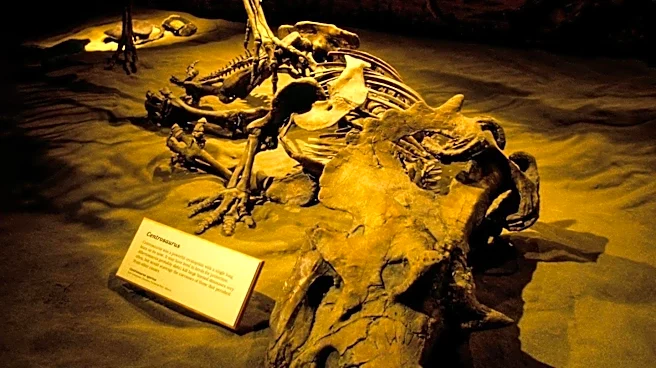
Alongside T. rex, Triceratops is highlighted as one of the most iconic North American dinosaurs of the same era, living approximately 68-66 million years ago. Triceratops, known for its enormous frilled skull and three horns, could grow up to 29.5 feet long, stand about 9.8 feet tall, and weigh as much as 26,000 pounds. It was a sturdy herbivore that likely used its headgear for both display and defense against predators like Tyrannosaurus rex.
Why It's Important?
The co-existence of Tyrannosaurus rex and Triceratops in the Late Cretaceous period in North America is a cornerstone of understanding prehistoric ecosystems. T. rex's role as the apex predator shaped the evolutionary pressures on herbivores, leading to defensive adaptations like the Triceratops's horns and frills. This dynamic illustrates a classic predator-prey relationship that drove significant evolutionary developments. The study of these two iconic dinosaurs provides crucial data for paleontologists to reconstruct the food webs, environmental conditions, and biodiversity of ancient North America, offering insights into how large terrestrial animals interacted and survived in a subtropical coastal stream system.
What's Next?
Ongoing paleontological research in formations like the Lance Formation in Wyoming continues to uncover new fossils, which could further refine our understanding of these dinosaurs and their environment. Future discoveries might provide more details on their social behaviors, growth patterns, and the precise nature of their interactions. Advanced analytical techniques applied to existing fossils could also reveal new information about their physiology, diet, and the broader ecological context of their time. Public interest in these dinosaurs remains high, driving educational initiatives and museum exhibits that continue to engage and inform about prehistoric life.
Beyond the Headlines
The enduring popularity of Tyrannosaurus rex and Triceratops in popular culture, from films to educational materials, underscores their significant impact on how society perceives dinosaurs. These two species serve as ambassadors for paleontology, sparking curiosity and inspiring future generations of scientists. Their iconic status also highlights the importance of fossil discoveries in shaping our collective imagination and understanding of Earth's deep history. The continuous scientific exploration of these creatures not only expands academic knowledge but also reinforces the value of preserving natural history and supporting scientific research.