







What's Happening?
An investigation by The Insider has revealed that a Chinese company, Shenzhen Xingkai Technology, is allegedly supplying mesh modems for Russian drones, with invoices reportedly sent to Russia's Alabuga drone plant. Undercover reporters, posing as Russian military
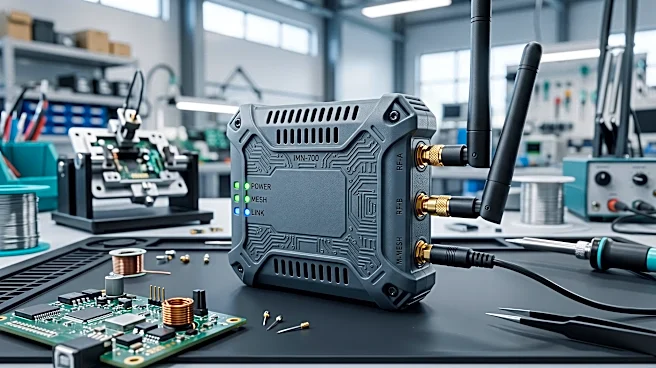
suppliers, ordered 500 drone mesh modems from Xingkai. The company's director, Jiang Qin, confirmed that his firm is the sole maker of the XK F-359 modem, which is used in upgraded Gerbera drones. The invoice for 19.5 million yuan (approximately $2.87 million) was reportedly billed to the Alabuga plant, which is known for producing most of Russia's long-range drones. The reporters explicitly stated that the end-user was a military production facility, and Jiang Qin reportedly raised no objections. The modems are crucial for linking drones into a radio network, allowing them to relay data and maintain communication even if some units are shot down, and enabling operators to steer drones around air defenses.
Why It's Important?
This investigation highlights a critical vulnerability in international sanctions regimes and the complex supply chains supporting Russia's military efforts. The alleged direct supply of key components from a Chinese company to a Russian military production facility, despite international sanctions, has significant implications for global geopolitics and trade. For the U.S. and its allies, this raises concerns about China's role in indirectly supporting Russia's war in Ukraine and the effectiveness of existing export controls. The ability of Russia to acquire advanced components like mesh modems, which enhance drone capabilities, directly impacts the effectiveness of Ukrainian air defenses and prolongs the conflict. The claim by Jiang Qin that a key chip in the modem is made by U.S. company AMD, which AMD denies selling to Xingkai, further complicates the issue, suggesting potential illicit procurement channels or misrepresentation. This situation underscores the challenges in enforcing sanctions and preventing the flow of critical technology to sanctioned entities.
What's Next?
The findings of this investigation are likely to trigger increased scrutiny from the U.S. and European governments on Chinese companies suspected of aiding Russia's military. There could be calls for stronger enforcement of existing sanctions and potentially new sanctions targeting companies like Shenzhen Xingkai Technology. AMD's denial of sales to Xingkai suggests a potential investigation into how their components might be ending up in Russian drones, possibly through third-party intermediaries or black markets. This could lead to enhanced due diligence requirements for technology companies to prevent their products from being diverted for military use by sanctioned entities. Ukraine and its allies will likely use this information to press for more stringent controls on technology exports to China and Russia, emphasizing the direct link between these components and the ongoing conflict. The incident may also prompt a re-evaluation of the effectiveness of current international sanctions and the need for more coordinated efforts to disrupt illicit supply networks.
Beyond the Headlines
This incident delves into the ethical complexities of global supply chains and corporate responsibility in times of conflict. The alleged willingness of a company to supply military-grade components to a sanctioned entity, even when explicitly informed of the end-user's military purpose, raises profound questions about corporate ethics and the enforcement of international law. It also highlights the 'gray areas' where commercial interests intersect with geopolitical conflicts, often with devastating consequences. The reliance on mesh modems for drone resilience, as described in the report, signifies a technological arms race where communication and jamming capabilities are paramount. This development could lead to a broader re-evaluation of how technology is controlled and monitored globally, potentially leading to more restrictive export policies for dual-use technologies. The long-term implications could include a more fragmented global technology market, as nations seek to secure their supply chains and prevent their innovations from being used against their interests or those of their allies.