


What's Happening?
Five Nordic countries—Denmark, Finland, Iceland, Norway, and Sweden—are advancing closer military integration within NATO by drafting a Nordic Defence Cooperation Agreement (NDCA). This initiative, announced on November 12, 2026, following a NORDEFCO
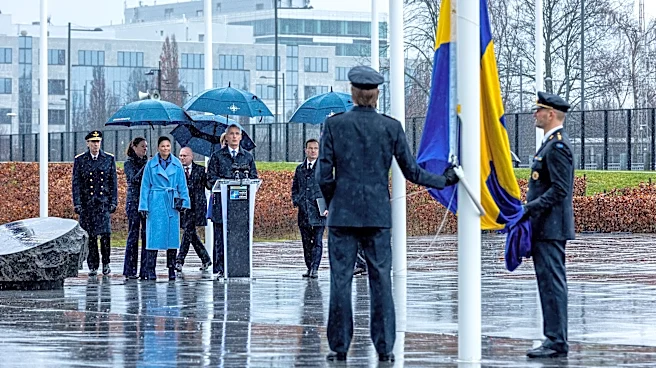
ministerial meeting in Oslo, aims to bolster collective defense capabilities and streamline joint military operations. The proposed agreement will establish a stronger legal framework for cross-border troop movements, joint operations, and logistical support, without creating a separate military alliance. This development reflects a significant shift in Northern European security, especially since Finland joined NATO in 2023 and Sweden in 2024, bringing all five Nordic nations into the Alliance. The region now commands approximately 250 modern combat aircraft, nearly 145 surface vessels, and about 100,000 military personnel in peacetime, representing combined national capabilities. This transformation is already evident within NATO's command structure, with all five Nordic countries falling under Joint Force Command Norfolk since December 2025, enhancing coordination across the Arctic, North Atlantic, and Northern Europe. NATO has also established a Multi-Corps Land Component Command in Mikkeli, Finland, and a Combined Air Operations Centre in Bodø, Norway.
Why It's Important?
This enhanced Nordic defense cooperation is crucial for strengthening NATO's northeastern flank, particularly in deterring Russia's continued military activities in the Baltic region and the High North. The geographically connected area, stretching from the Arctic to the Baltic Sea, is vital for NATO's defense strategy. Sweden's territory, including Gotland, is critical for controlling access to the Baltic Sea, while Denmark secures maritime approaches to the North Sea. Finland's extensive border with Russia and the Baltic states' exposure to Russian and Belarusian military pressure make close military coordination indispensable. The initiative also includes industrial expansion, with Nordic countries aiming to triple their ammunition production capacity by 2030 and coordinating joint procurement of unmanned aircraft and participation in NATO’s multinational tanker transport capabilities. These efforts address practical weaknesses that could be decisive in a prolonged conflict, ensuring that political commitments translate into common planning, sufficient ammunition stocks, effective command arrangements, and interoperable forces. The integration also extends to civilian preparedness, recognizing that a confrontation with Russia would involve cyberattacks, sabotage, and disruption of critical infrastructure, necessitating robust civilian institutions and secure supply chains.
What's Next?
The Nordic nations will continue drafting the Nordic Defence Cooperation Agreement (NDCA) to solidify the legal framework for military cooperation. This agreement is expected to facilitate cross-border troop movements, joint operations, and logistical support, further integrating their defense capabilities within NATO. The ongoing efforts to triple ammunition production capacity by 2030 will proceed, alongside coordinated procurement of unmanned aircraft and enhanced participation in NATO's multinational tanker transport capabilities. These initiatives aim to address potential weaknesses in a prolonged conflict. Furthermore, cooperation between defense ministers and representatives for civilian preparedness, under the Haga cooperation framework, will continue to focus on societal resilience, civil-military coordination, and preparations for major crises. This integrated approach acknowledges the multifaceted nature of modern threats, including cyberattacks and critical infrastructure disruption. The deeper integration will require continuous efforts to translate political commitments into common planning and effective command arrangements to ensure forces can operate seamlessly together.
Beyond the Headlines
The Nordic initiative signifies a fundamental shift in Northern European security, moving beyond traditional military alliances to a comprehensive, integrated defense strategy. The inclusion of civilian preparedness alongside military integration highlights a recognition that modern conflicts extend beyond conventional warfare, encompassing cyber warfare, critical infrastructure attacks, and societal resilience. This holistic approach underscores a broader understanding of national security, where the strength of civilian institutions and supply chains is as crucial as military might. The cooperation also reflects a proactive stance against potential Russian aggression, transforming the region into a more formidable deterrent. The emphasis on reducing legal and administrative barriers for military deployments during a crisis suggests a commitment to operational efficiency and rapid response, crucial elements in contemporary defense. This deeper integration could serve as a model for other regions within NATO, demonstrating how member states can leverage their collective strengths to enhance overall alliance security and adaptability in a complex geopolitical landscape.