




What's Happening?
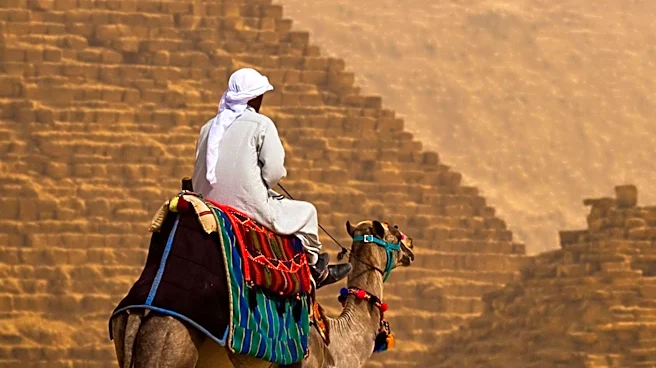
Recent analysis of ancient Egyptian art has revealed that while chariots were the predominant symbol of power and status, there were indeed rare instances of horseback riding. These depictions, found in various artifacts and temple reliefs, suggest that horseback riding was
not as uncommon as previously thought. The art primarily portrays military scouts and messengers on horseback, roles that were practical but largely ignored in official records. The rarity of these images in the historical record indicates that horseback riding was not a prestigious activity, unlike chariot use, which was heavily featured in royal propaganda. The art served as a tool for political messaging, focusing on the king's power and military might, often sidelining less glamorous roles such as horseback riders.
Why It's Important?
The discovery of horseback riding depictions in ancient Egyptian art challenges the long-held belief that horses were used exclusively for chariots. This finding suggests a more nuanced understanding of Egyptian military and social practices. The presence of mounted scouts indicates that horseback riding played a strategic role in military operations, providing reconnaissance and intelligence. This challenges the traditional narrative and highlights the complexity of ancient Egyptian society, where certain practices were not widely documented or celebrated. Understanding these nuances can provide deeper insights into the social hierarchy and cultural values of ancient Egypt, where prestige and propaganda often dictated what was recorded and remembered.
What's Next?
Further research into ancient Egyptian art and artifacts may uncover more instances of horseback riding, potentially reshaping our understanding of its role in Egyptian society. Scholars may focus on re-evaluating existing artifacts and exploring lesser-known sites for additional evidence. This could lead to a broader reassessment of the social and military structures of ancient Egypt, particularly regarding the roles and recognition of non-elite individuals. As more evidence comes to light, it may prompt a rethinking of how historical narratives are constructed and the factors that influence which aspects of history are preserved and celebrated.
Beyond the Headlines
The implications of this discovery extend beyond historical curiosity, touching on themes of cultural representation and the power of narrative. The fact that horseback riding was not prominently featured in Egyptian art suggests a cultural bias towards certain activities and roles. This highlights the importance of questioning historical narratives and considering the perspectives and contributions of marginalized groups. The study of ancient Egyptian art serves as a reminder of the selective nature of historical documentation and the need to critically assess the sources that shape our understanding of the past.