
What's Happening?
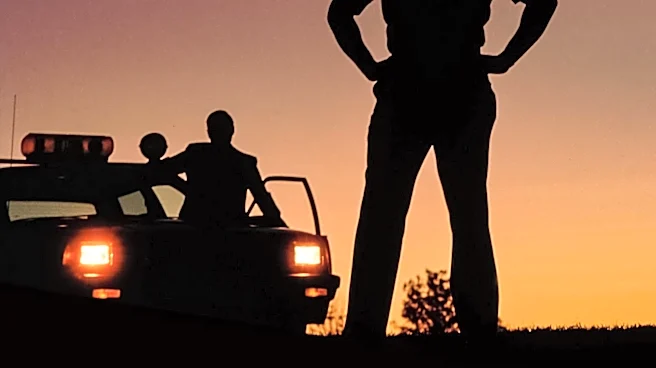
Ammon Bundy, a prominent anti-government figure, was arrested in Iron County, Utah, for driving an unregistered vehicle. The arrest occurred after an Iron County sheriff’s deputy observed his truck without a license plate on southbound I-15. Bundy provided
an expired Idaho driver’s license and admitted the vehicle was unregistered, asserting his belief in an "inalienable right" to travel freely without government permission. He refused to exit his vehicle, leading deputies to forcibly remove him. Bundy was charged with interfering with a peace officer, failure to obey an officer, driving without registration, and having no valid license. Following his release on bail, Bundy protested his arrest by walking eight miles on I-15 near Cedar City, despite Utah law prohibiting walking on freeways except in emergencies. He stated he would not register his vehicle but would appear in court.
Why It's Important?
This incident highlights the ongoing conflict between individual liberty claims and state regulations, particularly concerning vehicle registration and traffic laws. Bundy's assertion of an "inalienable right" to travel without government oversight challenges the legal framework that underpins public safety and infrastructure funding. His actions, including resisting arrest and protesting by walking on a freeway, draw attention to the tactics employed by anti-government movements to express dissent. The case also underscores the complexities faced by law enforcement in dealing with individuals who reject the legitimacy of certain laws. The legal proceedings will test the boundaries of individual rights versus state authority, potentially setting precedents or reinforcing existing interpretations of traffic laws and civil disobedience in Utah and beyond. This event also brings renewed attention to Bundy's history of confrontations with authorities, including the 2014 standoff in Nevada and the 2016 occupation of the Malheur National Wildlife Refuge.
What's Next?
Ammon Bundy has stated his intention to appear in court to challenge the charges, where he plans to present his argument for the "preservation of an inalienable right" to travel. This will likely involve a legal battle over the interpretation of constitutional rights versus state regulatory powers. The court's decision will be closely watched by both legal scholars and anti-government groups. Law enforcement agencies will continue to enforce traffic laws, and it remains to be seen if Bundy's actions will inspire similar protests or legal challenges from others. The incident may also prompt discussions within Iron County and Utah state government regarding public safety on freeways and the handling of individuals who resist lawful commands. Bundy's ongoing legal issues, including an open arrest warrant in Idaho, suggest that further confrontations with authorities are possible.
Beyond the Headlines
Ammon Bundy's arrest and subsequent protest delve into the philosophical underpinnings of American governance and individual freedom. His argument that the right to travel is God-given and not subject to government regulation reflects a strain of thought rooted in libertarian and anti-federalist ideologies. This perspective often clashes with the practical necessities of modern society, such as funding for roads, public safety, and the orderly administration of justice. The incident also raises questions about the effectiveness of civil disobedience as a means of political expression and the potential for such actions to escalate. The broader implications include the ongoing struggle to balance individual autonomy with collective well-being, and how society defines and enforces the limits of personal freedom in a structured legal system. This event serves as a microcosm of the larger ideological battles playing out in American politics regarding the role and scope of government.