


What's Happening?
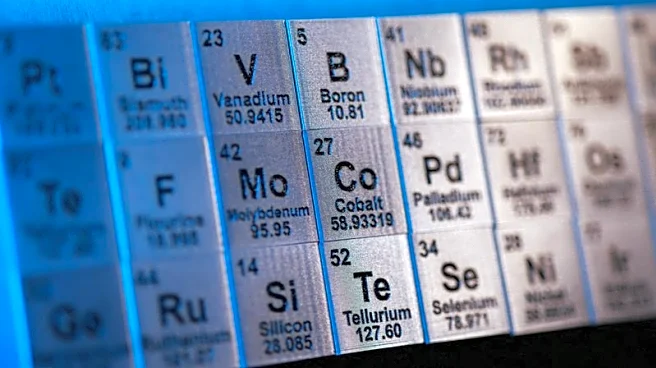
The United States recently hosted a critical minerals summit with representatives from various countries, including Argentina, Australia, and Chile, to address China's significant role in the global production of critical minerals. These minerals are
essential for manufacturing smartphones, weapons systems, lithium-ion batteries, and electric vehicles. Despite efforts to reduce China's influence, the U.S. faces a complex reality due to China's established low-cost manufacturing model and extensive public-private investment agreements. China currently accounts for over 80% of global battery production, with a significant portion dedicated to grid-scale batteries used for renewable energy storage. The U.S. has made strategic moves, such as acquiring stakes in lithium companies and negotiating trade agreements, but decoupling from China's production networks remains challenging.
Why It's Important?
The dominance of China in the critical minerals sector poses strategic and economic challenges for the U.S. As the global demand for renewable energy and electric vehicles grows, securing a stable supply of critical minerals becomes crucial. The U.S. aims to bolster its domestic production capabilities and reduce reliance on China to ensure energy security and technological advancement. However, the entrenched position of Chinese companies and their competitive pricing make it difficult for American firms to compete. This situation impacts U.S. foreign policy and economic strategies, as aligning with domestic and international stakeholders becomes increasingly complex.
What's Next?
Looking ahead, the U.S. must navigate geopolitical and economic landscapes to strengthen its position in the critical minerals market. This involves fostering partnerships with countries rich in mineral resources and investing in domestic production capabilities. The election of right-wing governments in South American countries like Argentina and Chile may offer opportunities for the U.S. to expand its influence. However, the challenge remains in developing a supply chain that can rival China's efficiency and cost-effectiveness. The U.S. will need to balance its 'America first' policy with global trade dynamics to achieve its goals.