









What's Happening?
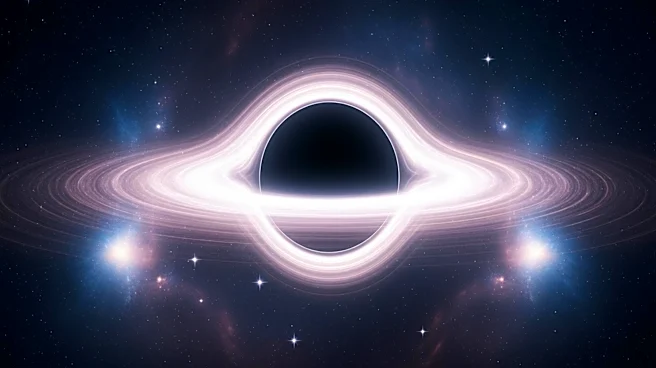
The Event Horizon Telescope (EHT) Collaboration unveiled the first image of Sagittarius A*, the supermassive black hole at the center of the Milky Way, on May 12, 2022. This image shows a bright, slightly lumpy ring of light surrounding a dark center,
which is the shadow cast by the black hole. Sagittarius A* is approximately 4 million times the mass of the Sun and is located about 27,000 light-years away from Earth. The image was created by linking eight radio observatories across the globe to form a virtual Earth-sized telescope. The process of stitching together the data from these observatories took about five years and involved over 300 researchers from 80 institutes. The image confirms predictions made by Einstein's Theory of General Relativity regarding the size of the emission ring.
Why It's Important?
This achievement is significant as it provides a direct visual confirmation of the existence of a supermassive black hole at the center of our galaxy, supporting the predictions of General Relativity. The ability to image such a distant and massive object demonstrates the capabilities of modern astronomical techniques and the collaborative efforts of the global scientific community. The image of Sagittarius A* offers a new opportunity to study the behavior of matter and gravity in extreme environments, potentially leading to new insights into the fundamental laws of physics. The success of this project also sets a precedent for future astronomical observations and the development of more advanced imaging techniques.
What's Next?
Following the successful imaging of Sagittarius A*, researchers aim to create dynamic visualizations, or 'movies,' of the black hole to observe the movement of plasma around it. This will allow scientists to test the behavior of gravity in extreme conditions more thoroughly. The EHT team plans to continue refining their methods and expanding their network of observatories to capture more detailed and frequent observations. These efforts could lead to a deeper understanding of black holes and their role in the universe, potentially uncovering new physics beyond current theories.
Beyond the Headlines
The imaging of Sagittarius A* not only confirms aspects of General Relativity but also highlights the challenges and complexities involved in observing such dynamic and distant objects. The variability of the black hole's environment required innovative approaches to data analysis and image reconstruction. This project underscores the importance of international collaboration in scientific research, as it involved contributions from numerous countries and institutions. The findings may also inspire future generations of scientists to explore the mysteries of the universe, pushing the boundaries of human knowledge and technological capabilities.