



What's Happening?
Photographers at NASA’s Johnson Space Center in Houston are actively documenting critical moments in human spaceflight, capturing everything from astronaut training and engineering tests to mission control operations and milestone celebrations. This team,
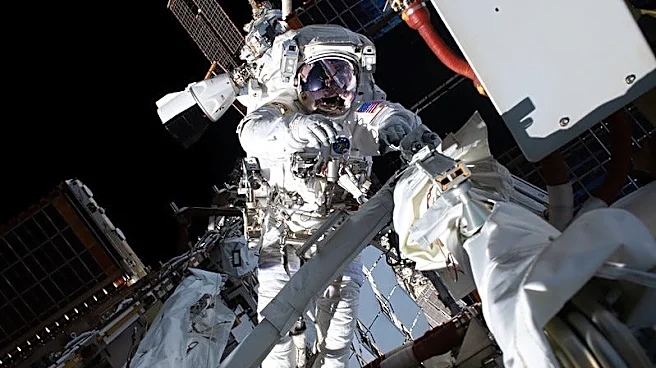
including Robert Markowitz, Bill Stafford, James Blair, Helen Arase Vargas, and Luna Posadas Nava, preserves the history of space exploration and highlights the individuals and teams driving future missions. Robert Markowitz, with over three decades of experience, has documented the space shuttle program, 25 years of continuous human presence on the International Space Station, and the Artemis II mission. Bill Stafford focuses on framing images to convey the significance of moments, while James Blair brings a photojournalism background to document people and technology. Helen Arase Vargas, with a background in photojournalism and aerospace photography, emphasizes public interest and the ethical aspects of her work. Luna Posadas Nava, who joined before the Artemis II mission, focuses on visualizing and expanding the boundaries of what is possible, particularly highlighting the contributions of women in science.
Why It's Important?
The work of these NASA photographers is crucial for several reasons. Firstly, they serve as the visual historians of human spaceflight, creating an archive that documents technological advancements, human endeavors, and scientific discoveries. This visual record is vital for educational purposes, inspiring future generations, and providing context for ongoing and future missions. Secondly, their images play a significant role in public engagement, allowing the public to connect with and understand the complex and often remote world of space exploration. By showcasing the people behind the missions, they humanize NASA's efforts and foster a sense of shared achievement. Thirdly, the diverse perspectives of these photographers, from Markowitz's long-standing documentation to Posadas Nava's focus on representation, ensure a comprehensive and inclusive portrayal of NASA's activities, reflecting the varied contributions to space exploration. Their work not only informs but also shapes public perception and support for space programs.
What's Next?
The photographers at NASA’s Johnson Space Center will continue to document the ongoing and future phases of human spaceflight, particularly focusing on the Artemis missions, which aim to return humans to the Moon and eventually send them to Mars. This will involve capturing new astronaut training, the development and testing of advanced spacecraft and lunar habitats, and the operational aspects of these complex missions. Their work will also likely highlight the scientific discoveries made during these missions and the international collaborations involved. As technology evolves, the photographers may also incorporate new imaging techniques and tools to capture even more detailed and immersive perspectives of space exploration. The continued emphasis on public engagement means their images will remain central to NASA's communication strategies, ensuring that the public stays informed and inspired by the progress of human spaceflight.
Beyond the Headlines
Beyond simply documenting events, the work of NASA photographers carries deeper implications for cultural and scientific understanding. Their images contribute to the collective human narrative of exploration and ambition, shaping how society perceives its place in the universe and its capacity for innovation. The visual storytelling aspect helps demystify complex scientific and engineering feats, making them accessible to a broader audience. Furthermore, the emphasis on capturing the human element—the astronauts, engineers, and scientists—underscores the collaborative and dedicated nature of space exploration. This can foster a sense of unity and shared purpose, transcending national boundaries. The long-term impact of these photographs lies in their ability to serve as historical artifacts, influencing future generations of scientists, engineers, and explorers, and continually reinforcing the value of pushing the boundaries of human knowledge and capability.