



What's Happening?
Vermont is facing a severe and growing challenge from river erosion, identified as the primary natural threat to its residents. This issue was highlighted by the experiences of Julie Rapczynski, whose home on Nasmith Brook was destroyed by erosion following
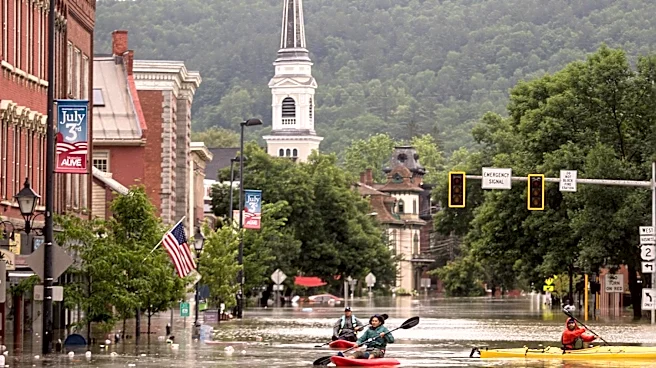
torrential rains in July 2023 and 2024, despite not being in a FEMA-mapped flood zone. River erosion is responsible for the majority of the state's flood damage, including over $800 million in destruction during the 2023 and 2024 floods. Scientific assessments indicate that most of Vermont's 7,000 miles of rivers are unstable, making their banks prone to collapse during storms, leading to landslides, road destruction, and homes falling into waterways. Over 21,000 buildings, housing tens of thousands of Vermonters, are located in these vulnerable river corridors. The state's historical approach of controlling rivers through dams and straightening has exacerbated the problem by disconnecting rivers from their natural floodplains, leading to a 'fire hose effect' during heavy rainfall. Currently, about 75% of Vermont's rivers are disconnected from their floodplains.
Why It's Important?
The escalating river erosion in Vermont has significant implications for property owners, public safety, and state finances. Many homes at risk are not covered by FEMA flood maps, which often do not account for erosion, leaving homeowners without federal buyout options. The state's shift in policy towards giving rivers more space to revert to natural paths is a long-term strategy, but it leaves current at-risk residents with few immediate solutions. The lack of a robust, continuously funded state buyout program means that individuals like Julie Rapczynski, despite being able to relocate through a temporary state fund, represent a rare success story. The financial burden on towns, such as Plainfield, which faces a potential $12-21 million cost to rebuild a road destroyed by erosion against an annual budget of $1.8 million, underscores the economic vulnerability of communities. Furthermore, the reliance on temporary fixes like riprap, which often fail, highlights the need for more sustainable and comprehensive mitigation strategies to protect both lives and property.
What's Next?
Vermont's 2024 Flood Safety Act, which will require a new state permit for construction in river corridors, is expected to take effect in two years. This legislation aims to prevent new development in high-risk areas, though experts like Kevin Geiger, chief planner for Two Rivers-Ottauquechee Regional Commission, note it only 'stops stabbing the patient' rather than solving the existing problem. State officials anticipate FEMA's flood maps will be updated by 2030, and in some communities by 2027, but these updates are not expected to include erosion risks. The Agency of Natural Resources recommended an ongoing minimum of $5 million for the state's buyout fund, but lawmakers have not prioritized this, citing other pressing needs like food, housing, and healthcare. Without sustained funding, the state lacks a proactive plan to identify and assist properties at risk before the next flood. Homeowners like Amy Seoane, who received a FEMA buyout offer despite being outside designated flood zones, face difficult decisions due to Vermont's housing shortage, questioning whether to accept buyouts or risk future damage without river work.
Beyond the Headlines
The struggle against river erosion in Vermont reveals deeper systemic issues related to land management, climate change adaptation, and governmental funding priorities. The historical practice of controlling rivers for development has inadvertently created a more unstable environment, demonstrating the long-term consequences of human intervention in natural systems. The disconnect between FEMA's flood mapping, which often excludes erosion risks and outdated land-use patterns, and the on-the-ground reality for residents highlights a critical gap in national disaster preparedness. The state's challenge in balancing immediate humanitarian needs with long-term ecological restoration reflects a broader societal dilemma in addressing climate change impacts. The reluctance to fund proactive measures like buyouts, despite their potential to save lives and taxpayer money in the long run, underscores the political difficulty of investing in preventative infrastructure over reactive disaster response, especially when competing with other social priorities.