

What's Happening?
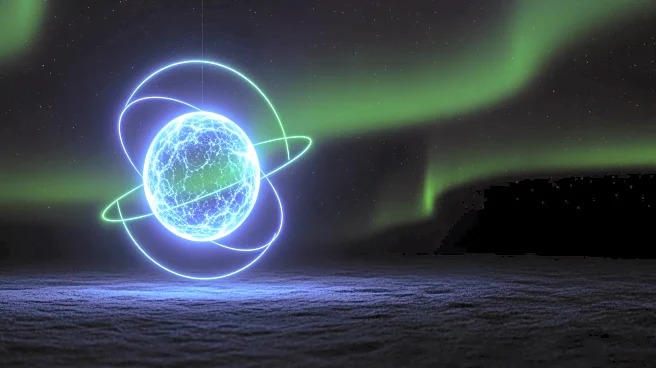
Researchers from the University of Hong Kong (HKU) and the University of California, Los Angeles (UCLA) have uncovered the mechanism that powers the electric fields responsible for auroral displays. The study, published in Nature Communications, reveals
that Alfvén waves, which are plasma waves traveling along Earth's magnetic field lines, act as a natural power source for these electric fields. The research involved analyzing data from NASA's Van Allen Probes and THEMIS mission, confirming that these waves continuously transfer energy to the auroral acceleration region.
Why It's Important?
This discovery provides a significant advancement in understanding the physics behind auroras, which are not only a natural spectacle but also a subject of scientific interest due to their implications for space weather. Understanding the mechanism behind auroral displays can help in predicting space weather events that affect satellite operations and communication systems on Earth. The findings also offer a universal model that could be applied to study auroras on other planets, enhancing our knowledge of planetary atmospheres and magnetic fields.
Beyond the Headlines
The research highlights the importance of interdisciplinary collaboration in scientific discoveries. By combining expertise in Earth's auroral physics and planetary space physics, the teams from HKU and UCLA have bridged the gap between Earth science and planetary exploration. This approach could pave the way for future studies that explore similar phenomena on other planets, potentially leading to new insights into the dynamics of planetary systems.