



What's Happening?
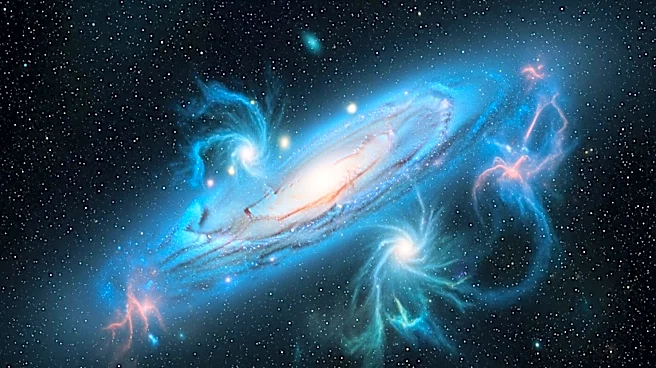
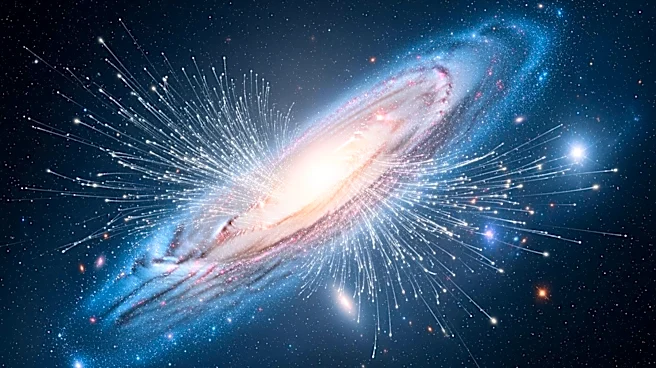
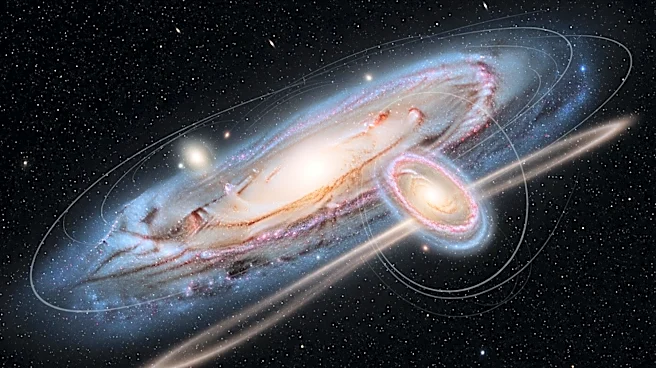
Astronomers have identified a 'galaxy-killing wind' that may explain the prevalence of massive 'dead' galaxies in the early universe. This wind, driven by cosmic collisions and intense star formation, expels the gas necessary for star creation, leading
to the rapid demise of galaxies. The discovery was made using the James Webb Space Telescope (JWST) and the Atacama Large Millimeter/submillimeter Array (ALMA), focusing on a galaxy named CRISTAL-02. This galaxy, observed a billion years after the Big Bang, is undergoing a rapid growth spurt, forming stars at twice the rate of similar galaxies. The observations revealed a large plume of cold gas being ejected, a sign of the galaxy's impending death. The study, led by Dr. Rebecca Davies and Associate Professor Deanne Fisher, suggests that such winds are a widespread phenomenon, potentially explaining the existence of many dead galaxies in the early universe.
Why It's Important?
This discovery provides crucial insights into the lifecycle of galaxies and the dynamics of the early universe. Understanding the mechanisms behind the rapid death of galaxies helps astronomers refine models of cosmic evolution and the role of star formation in galaxy development. The findings challenge previous theories that attributed the early demise of galaxies to factors like dark energy, offering a simpler explanation tied to observable phenomena. This research could reshape our understanding of galaxy formation and the conditions that lead to their extinction, impacting theories about the universe's expansion and the distribution of matter.
What's Next?
Future research will likely focus on identifying more galaxies experiencing similar 'winds' to determine the prevalence and impact of this phenomenon. Continued observations with JWST and ALMA will help refine models of galaxy evolution and test the new theory against other potential explanations. The study of CRISTAL-02 and similar galaxies could lead to a deeper understanding of the processes that govern the universe's structure and the fate of galaxies. Researchers may also explore the implications of these findings for the role of supernovae and cosmic collisions in shaping the universe.