





What's Happening?
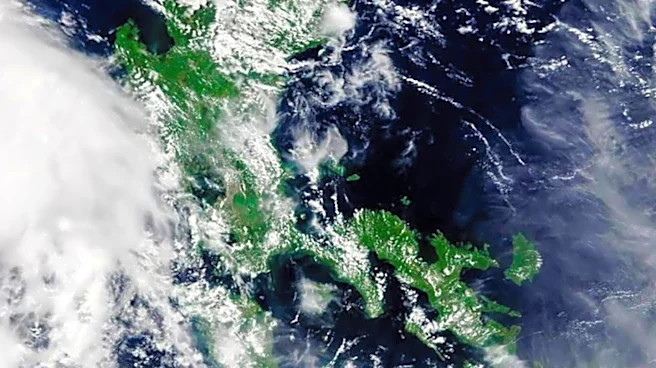
Taiwan's Ministry of National Defense has commissioned an artificial intelligence-based system designed to rapidly analyze satellite imagery. This system, costing approximately US$1.45 million, aims to significantly speed up the detection of People’s
Liberation Army (PLA) ships, aircraft, and missile launchers. The AI will be capable of analyzing imagery of a 100-square-kilometer area within minutes, thereby reducing the time and human resources traditionally required to track changes in PLA force deployments. The contract for this system was awarded to ThinkTron, a Taiwan-Japan company specializing in AI, geographic information systems, and monitoring technologies, through a public procurement procedure by the Communications Development Office of Taiwan’s Ministry of National Defense.
Why It's Important?
This acquisition marks a crucial step in Taiwan's efforts to enhance its intelligence gathering and defense capabilities against potential threats from mainland China. By automating and accelerating the analysis of satellite imagery, Taiwan can achieve a more real-time understanding of PLA movements and deployments. This improved situational awareness is vital for early warning and effective response planning, potentially mitigating the impact of any sudden military actions. The ability to quickly identify military assets, even when operating among civilian shipping or with transponders switched off, provides a significant advantage in a complex operational environment. This technological upgrade underscores Taiwan's commitment to leveraging advanced solutions to bolster its national security in the face of persistent geopolitical tensions.
What's Next?
The AI system is scheduled for completion by the end of April. Upon deployment, its primary function will be the rapid processing of imagery and information received from existing satellites. The technology is designed to automatically compare new images with archived ones, flagging any changes for human analysts. This will allow for more efficient identification of targets, including ships longer than 10 meters, aircraft, missile launchers, and radar vehicles. Max Lo, executive director of the Taiwan International Strategic Study Society, suggests that the results of this satellite image analysis could be cross-referenced with signals intelligence data for a more comprehensive picture. The successful integration and operation of this system will be a key focus for Taiwan's defense establishment in the coming months.
Beyond the Headlines
The adoption of AI for military intelligence highlights a broader trend in modern defense, where artificial intelligence and machine learning are becoming indispensable tools for processing vast amounts of data and gaining a strategic edge. This move by Taiwan reflects a recognition that human analysts alone cannot keep pace with the volume and complexity of information generated by modern surveillance. Ethically, the use of AI in military applications raises questions about autonomous decision-making and the potential for algorithmic bias, though in this context, the AI serves as an analytical aid rather than a decision-maker. Culturally, it signifies Taiwan's embrace of advanced technology as a cornerstone of its defense strategy, moving towards a more technologically sophisticated approach to national security. This development could also spur further innovation in AI-driven defense solutions globally.