






What's Happening?
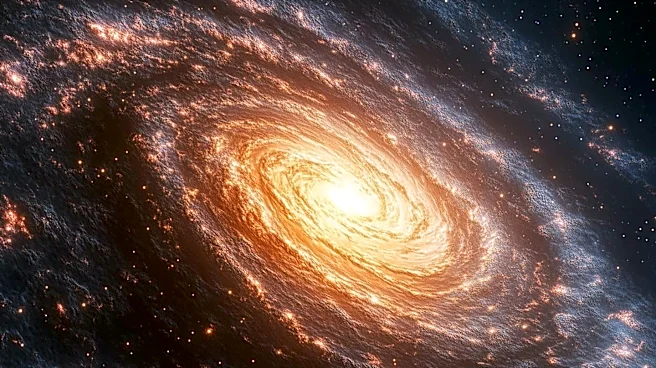
NASA's Chandra X-ray Observatory has provided new insights into the structure of the Milky Way's spiral arms. By analyzing X-ray rings generated by gamma-ray bursts (GRBs) that bounce off dust clouds, researchers have determined that the outer spiral arms may
be more distant than previously thought. This discovery was made by measuring the distances to dust clouds in the Milky Way's spiral arms using data from both Chandra and ESA's XMM-Newton. The study, published in the Astronomy & Astrophysics journal, suggests that the Perseus, Outer, and Outer Scutum-Centaurus arms are about 10% more distant from the Galactic Center than earlier estimates. This finding could lead to revisions in the understanding of the Milky Way's mass and structure.
Why It's Important?
The discovery has significant implications for our understanding of the Milky Way's structure and mass. Accurate measurements of the distances to the spiral arms are crucial for determining the galaxy's mass, which in turn affects how wide the arms stretch. This research provides a more precise method of measuring these distances, relying on geometry rather than assumptions about the galaxy's rotation. The findings could lead to a better understanding of the Milky Way's formation and evolution, as well as the distribution of mass within the galaxy. This research also highlights the importance of continued observation and analysis of gamma-ray bursts, which are rare but provide valuable data for studying the galaxy's structure.
What's Next?
The research team plans to continue monitoring for gamma-ray bursts to further refine their measurements of the Milky Way's spiral arms. However, the rarity of these events poses a challenge, as only a handful have been observed over the past 25 years. The team will remain vigilant for new GRBs that can provide additional data. Future studies may also focus on integrating these findings with other astronomical data to develop a more comprehensive model of the Milky Way's structure. The ongoing management of the Chandra program by NASA's Marshall Space Flight Center and the Smithsonian Astrophysical Observatory will support these efforts.