
What's Happening?
Researchers from Emory University and the Georgia Institute of Technology have developed an AI-powered device called CapuchinAI, designed to study primate cognition in the wild. The device, equipped with facial recognition software, a touchscreen, and a banana
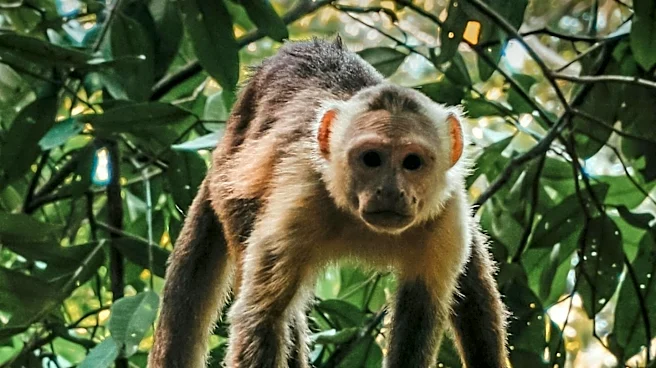
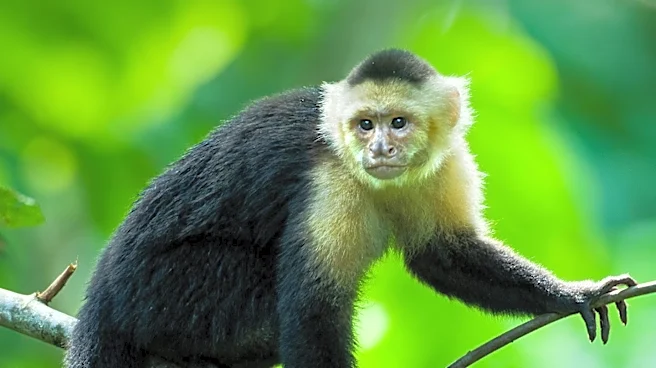
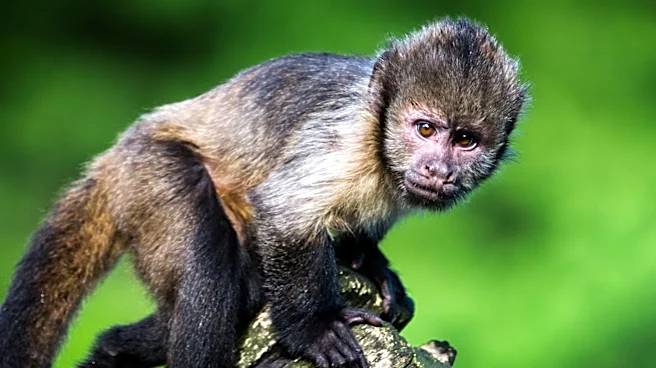
dispenser, was placed in Costa Rica's Taboga Forest Reserve. When a monkey interacts with the touchscreen, it receives a banana slice. The study, published in the American Journal of Primatology, observed 16 capuchins interacting with the device, with 10 learning to trigger rewards. This experiment aims to explore primate learning and cognitive abilities in their natural habitat, offering insights into how these animals adapt and learn outside laboratory settings.
Why It's Important?
This research provides a novel approach to studying primate cognition in natural environments, which could lead to a better understanding of how primates learn and adapt in the wild. The findings could have implications for conservation efforts, as understanding primate behavior in their natural habitat can inform strategies to protect these species. Additionally, the use of AI in wildlife research represents a significant advancement in the methods available to scientists, potentially leading to more accurate and comprehensive data collection.
What's Next?
The researchers plan to enhance the device to conduct more complex experiments, testing various cognitive abilities such as learning capabilities, impulse control, and memory. Future iterations of the device may also recognize individual monkeys, allowing for personalized experiments. This ongoing research could provide deeper insights into primate cognition and behavior, contributing to the broader field of animal cognition and conservation biology.