





What's Happening?
An interdisciplinary study, involving researchers from the Leibniz Institute for Farm Animal Biology (FBN) in Dummerstorf and universities in Rostock, Munich, and Vienna, has found that incorporating willow leaves into cattle diets can reduce nitrous
oxide emissions from animal urine by up to 81% and ammonia emissions by 14%. This discovery offers a potential solution to a significant challenge in sustainable livestock management. The active agent identified is salicin, a precursor to salicylic acid found in willow foliage, which influences nitrogen metabolism within the animals. The study highlights that the effect is due to the collective synergy of various bioactive compounds in the leaves, leading to a reduction in reactive nitrogen excreted and subsequently less microbial conversion into N₂O and NH₃ at ground level.
Why It's Important?
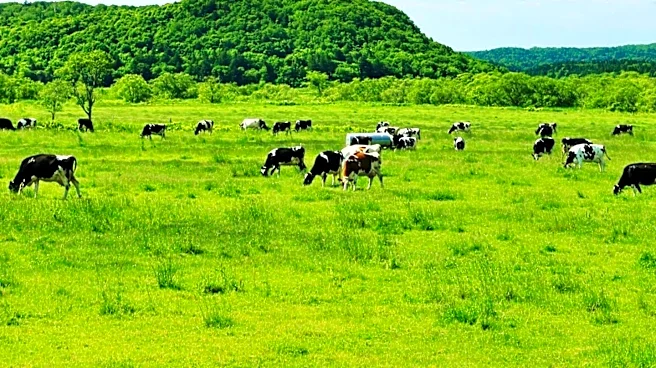
The agricultural sector faces substantial environmental burdens from nitrogen compounds, accounting for approximately 80% of global ammonia emissions and 81% of nitrous oxide emissions. Nitrous oxide, with a warming potential roughly 300 times greater than carbon dioxide, poses a significant climate challenge. Ammonia contributes to soil acidification and ecosystem eutrophication. This research is particularly important for pasture-based systems, where controlling emissions directly from grazing cattle has been difficult. The use of willow as a fodder crop, already utilized in markets like the United States and New Zealand, presents a dual-use profile that could reduce external input costs for traditional forage while providing environmental benefits. This approach could help the U.S. agricultural industry mitigate its environmental footprint and contribute to climate change efforts.
What's Next?
The transition from experimental data to farm-level economics will require further field trials. These trials will need to account for variables such as soil types, local climate conditions, microbial activity in pastures, and actual animal consumption rates to scale the findings to commercial operations. Researchers are also investigating the effect of willow extracts on manure and slurry management and evaluating other species with similar properties, such as poplar, to broaden the potential feed base. The study suggests the development of silvopastoral systems, which integrate grazing and forestry, where trees serve as an on-site feed source, improve microclimates, and reduce the ecological footprint of production units, creating a more closed-loop nutrient management system.
Beyond the Headlines
The findings could lead to a paradigm shift in livestock management, moving towards more integrated and ecologically sound practices. The concept of silvopastoral systems, where trees are not just for timber but also for animal feed and environmental benefits, could transform land use in agricultural regions. This approach aligns with broader sustainability goals, promoting biodiversity and soil health while addressing climate change. The economic implications for farmers could be substantial, potentially reducing reliance on external feed sources and chemical inhibitors, leading to cost savings and increased resilience in agricultural systems. This research also underscores the importance of natural compounds in addressing complex environmental challenges.