


What's Happening?
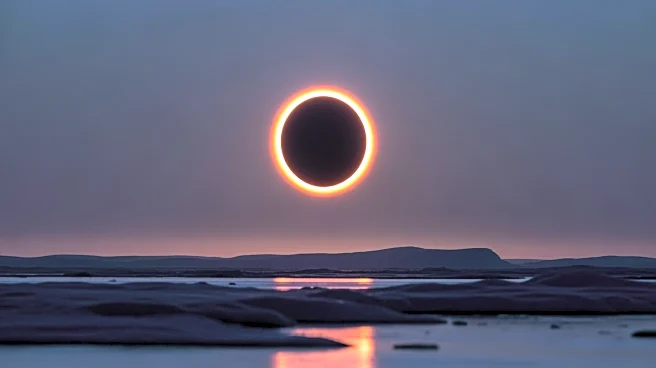
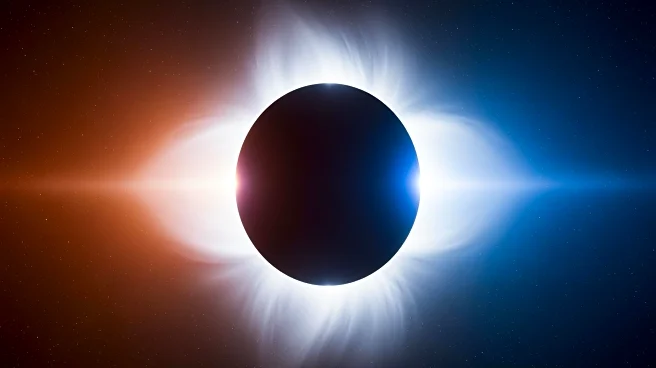
NASA has announced that a total solar eclipse is scheduled to occur on August 12, 2026. This celestial event will be the second and final solar eclipse of the year. Unlike the annular solar eclipse that occurred earlier, this total eclipse will see the Moon
completely obscure the Sun for a brief period. The eclipse will begin at 15:34 UTC and end at 19:57 UTC, with totality occurring from 16:58 UTC to 18:34 UTC. The path of totality will start in remote Siberia and pass through eastern Greenland, western Iceland, and northern Spain, concluding east of the Balearic Islands in the Mediterranean. Notably, regions such as Mallorca, Menorca, and Ibiza in Spain, as well as Breiðafjörður Bay in Iceland, will experience the full duration of totality, lasting up to 2 minutes and 18 seconds.
Why It's Important?
The total solar eclipse of August 2026 is significant for both scientific and public interest reasons. It provides a rare opportunity for scientists to study the Sun's corona and other solar phenomena that are only visible during totality. For the general public, it offers a chance to witness a spectacular natural event that can inspire interest in astronomy and science. The eclipse will also have economic implications, as regions within the path of totality may see increased tourism, benefiting local businesses and economies. Additionally, the event underscores the importance of public safety measures, such as the use of eclipse glasses, to prevent eye damage during viewing.
What's Next?
As the date of the eclipse approaches, preparations will likely intensify in regions within the path of totality. Local governments and tourism boards may organize events and viewing parties to attract visitors. Educational institutions and scientific organizations might conduct outreach programs to educate the public about the eclipse and safe viewing practices. Furthermore, researchers will prepare to deploy equipment and conduct experiments to maximize the scientific yield from the event. The next total solar eclipse, projected for August 2, 2027, is already being anticipated as it promises to be the longest of the century, offering over six minutes of totality.