




What's Happening?
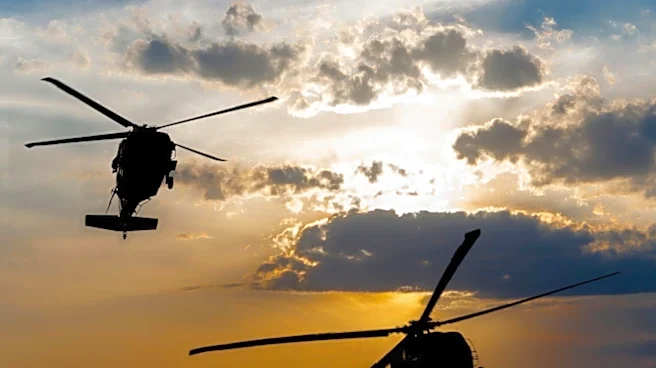
The U.S. Army is significantly changing its helicopter pilot training program by outsourcing the initial phase to a private company, M1 Support Services. This Texas-based aviation contractor will manage the 'Flight School Next' program, providing aircraft,
equipment, simulators, and flight instruction for 800 to 1,500 new pilots annually at Fort Rucker, Alabama. The contract, potentially worth up to $10 billion over 26 years, aims to modernize training and achieve long-term cost savings. This move represents a departure from the traditional model where senior Army helicopter pilots served as instructors for junior counterparts. The Army believes this shift will enhance foundational skills among new military helicopter pilots. While M1 Support Services will handle early flight training, the Army will retain oversight of subsequent specialized training for different helicopter types. The exact start date for the new program has not been announced.
Why It's Important?
This outsourcing initiative marks a fundamental shift in U.S. Army aviation training, potentially impacting military readiness and the career paths of Army aviators. By entrusting initial flight instruction to a civilian contractor, the Army aims to address concerns that its current training model may not be adequately preparing junior pilots for advanced flight operations. Major General Clair Gill, commanding general of the Army's Aviation Center of Excellence, stated that 'Flight School Next' will deliver new pilots with 'far better foundational skills' while also providing 'significant long-term savings.' This could lead to a more efficient and cost-effective training pipeline, allowing the Army to reallocate resources. However, it also raises questions about the long-term implications of reducing the role of experienced military aviators in foundational instruction and the potential impact on military culture and expertise development within the service.
What's Next?
The U.S. Army will proceed with the implementation of the 'Flight School Next' program with M1 Support Services at Fort Rucker, Alabama. The transition will involve establishing the necessary infrastructure and personnel to train between 800 and 1,500 new pilots each year. The Army will continue to monitor the effectiveness of this new model, particularly in how well it prepares pilots for subsequent advanced military flight training. There will likely be ongoing assessments to ensure the program meets its objectives of modernizing training and achieving cost efficiencies. The success of this outsourcing effort could influence future decisions regarding civilian involvement in other aspects of military training across various branches of the U.S. armed forces. The Army will also need to manage the integration of these civilian-trained pilots into its existing military aviation structure.
Beyond the Headlines
The decision to outsource a core component of military pilot training reflects a broader trend within the U.S. military to leverage private sector capabilities for specialized services, driven by goals of efficiency and modernization. This move could set a precedent for other branches of the military to consider similar outsourcing for foundational training, potentially altering the traditional military career progression for instructors and the internal development of expertise. Ethically, it raises questions about the balance between cost-effectiveness and maintaining intrinsic military control over critical training functions. The long-term cultural impact on Army aviation, where senior pilots traditionally mentored junior ones, will be a significant area to observe. Furthermore, the reliance on a civilian contractor for such a vital role could introduce new considerations regarding national security, oversight, and the potential for skill gaps if the military's internal training capacity diminishes over time.