

What's Happening?
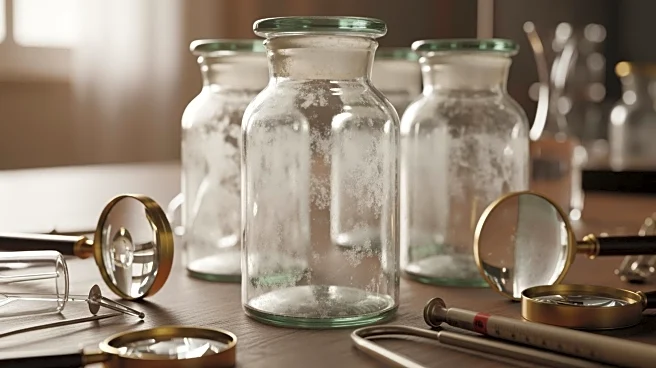
Scientists have developed a method to study Charles Darwin's original specimens from his HMS Beagle voyage without opening the nearly 200-year-old jars that preserve them. Using a portable laser spectroscopy technique called Spatially Offset Raman Spectroscopy
(SORS), researchers analyzed the chemical composition of preservation fluids in 46 historic specimens at the Natural History Museum in London. This method allows for the identification of preservation fluids and container materials, providing insights into historical preservation practices. The project, a collaboration between the Science and Technology Facilities Council, the Natural History Museum, and Agilent Technologies, offers a non-invasive way to monitor and care for invaluable specimens.
Why It's Important?
This breakthrough in non-invasive analysis of historical specimens is significant for museums and researchers worldwide. By preserving the integrity of these specimens, scientists can continue to study them without risking damage from exposure or contamination. This method enhances the ability to track the condition of collections, ensuring their longevity for future research. The technique could revolutionize how museums manage their collections, providing a powerful tool for conservation and study. It also highlights the potential for similar technologies to be applied in other fields, such as archaeology and art restoration, where preserving the original state of artifacts is crucial.