


What's Happening?
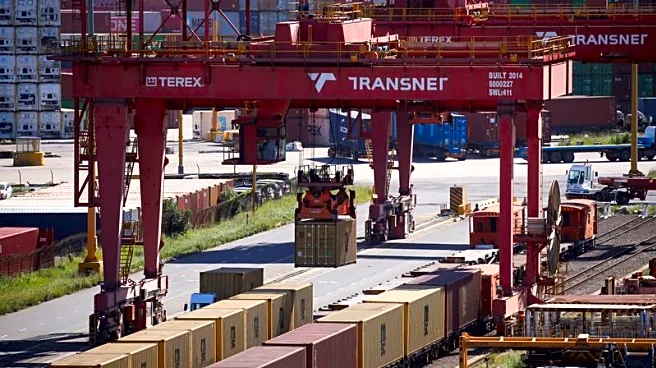
China's trade surplus surged to a record of nearly $1.2 trillion in 2025, despite increased tariffs from the U.S. under President Trump's administration. The Chinese government reported that exports rose by 5.5% to $3.77 trillion, while imports remained
steady at $2.58 trillion. This growth was driven by strong global demand for computer chips, electric vehicles, and other manufactured goods. Although exports to the U.S. fell by 20%, China compensated with increased shipments to Africa, Southeast Asia, and Europe. The China Association of Automobile Manufacturers noted a 21% increase in auto exports, particularly electric and hybrid vehicles. Economists predict that exports will continue to bolster China's economy in 2026, despite ongoing trade tensions.
Why It's Important?
The record trade surplus highlights China's resilience in the face of U.S. tariffs and its ability to diversify export markets. This development underscores the shifting dynamics in global trade, where China is increasingly looking beyond the U.S. to sustain its economic growth. The surge in exports, particularly in technology and automotive sectors, suggests a robust demand for Chinese goods worldwide, which could influence global supply chains and market competition. For the U.S., the decline in imports from China may impact domestic industries reliant on Chinese components, potentially leading to higher costs and supply chain adjustments. The situation also reflects broader geopolitical tensions and the ongoing trade war's impact on international economic relations.
What's Next?
China is expected to continue focusing on expanding its export markets while boosting domestic consumption to balance its economic growth. The Chinese government may implement policies to encourage consumer spending and investment, although previous efforts have shown limited success. Economists anticipate that China's trade surplus will remain above $1 trillion in 2026, with exports growing at a slower pace. The U.S. and other countries may respond by reassessing their trade policies and strategies to mitigate the impact of China's expanding global influence. Additionally, ongoing geopolitical tensions could lead to further trade negotiations or disputes, affecting international economic stability.