
What's Happening?
A study conducted by researchers at University College London has demonstrated that humans can detect objects buried under sand without direct contact, using a phenomenon known as remote touch. The research,
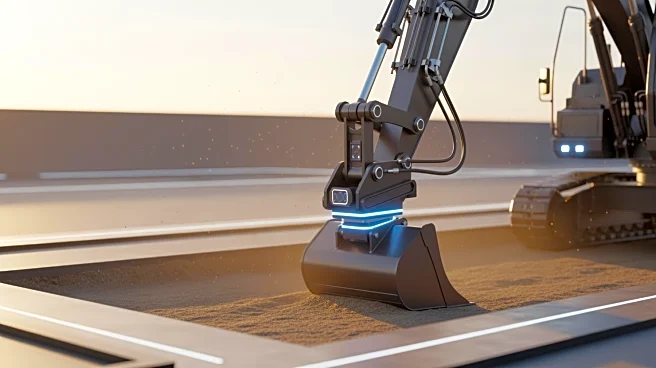
led by Lorenzo Jamone, involved experiments where participants successfully identified hidden objects by sensing faint cues through sand. The study compared human fingertips with a tactile robot, revealing that humans could detect objects at an average distance of 2.72 inches. This discovery expands the understanding of tactile perception, suggesting that touch can gather information from a distance, challenging previous assumptions about the limits of human sensory capabilities.
Why It's Important?
The findings have significant implications for the development of robotic technologies and human-machine interfaces. By understanding how humans can detect objects without direct contact, researchers can design more sensitive and effective robotic systems for applications in search and rescue, archaeology, and space exploration. The ability to sense buried objects remotely could lead to advancements in non-invasive exploration techniques, reducing the need for extensive excavation or disturbance of materials. This research also highlights the potential for robots to operate in environments where traditional sensing methods are limited, offering new solutions for complex challenges in various fields.
What's Next?
Future research will likely focus on refining the technology and exploring its applications in different environments, such as gravel or clay. The study's insights could lead to the development of new tools for detecting structural hazards or locating fragile artifacts without causing damage. As the technology advances, it may also be integrated into robotic systems used in disaster response or planetary exploration, enhancing their ability to navigate and analyze challenging terrains. Continued collaboration between human and robotic studies will be essential to fully realize the potential of remote touch sensing.