

What's Happening?
A new study by Professor Joachim Kopp of Johannes Gutenberg University Mainz and Dr. Azadeh Maleknejad from Swansea University proposes that gravitational waves may have played a crucial role in the formation of dark matter during the universe's earliest
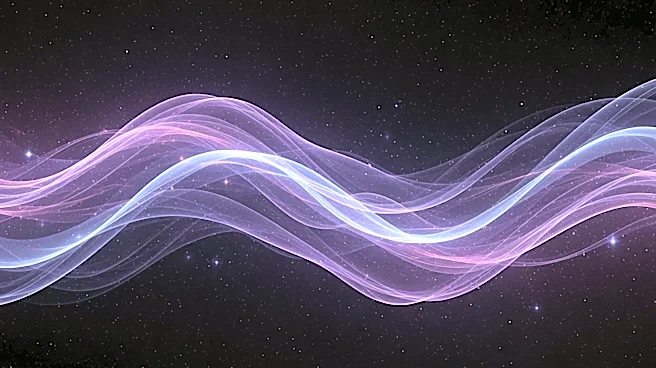
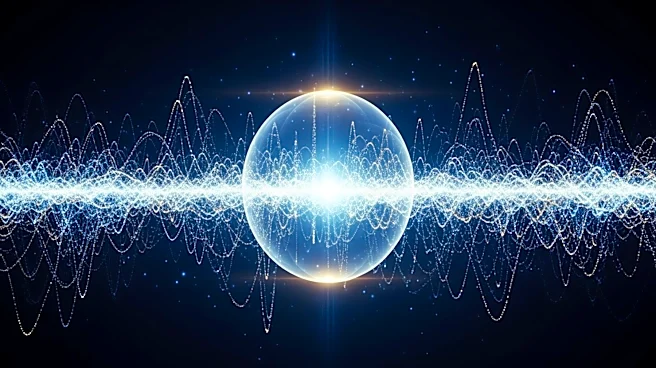
moments. Published in Physical Review Letters, the research introduces calculations suggesting that stochastic gravitational waves could have given rise to dark matter. These waves, which are ripples in spacetime, may have been converted into dark matter particles, offering a new mechanism for dark matter production. The study suggests that early gravitational waves could have produced fermions, a class of particles that includes electrons and protons, which later gained mass and evolved into dark matter particles.
Why It's Important?
The study addresses one of the biggest unanswered questions in particle physics: the origin of dark matter, which constitutes roughly 23 percent of the universe. Understanding the formation of dark matter is crucial as it influences the structure and evolution of the universe. The research provides a new perspective on how dark matter could have formed, potentially guiding future experiments and observations aimed at uncovering its true nature. This could have significant implications for our understanding of the universe and the fundamental forces that govern it.
What's Next?
The researchers plan to conduct numerical calculations to improve the accuracy of their predictions and explore further possible effects of gravitational waves in the early universe. This includes investigating mechanisms that could account for the difference in particles and antiparticles produced. The study opens new avenues for research into the role of gravitational waves in cosmic history and their potential impact on the formation of dark matter.