





What's Happening?
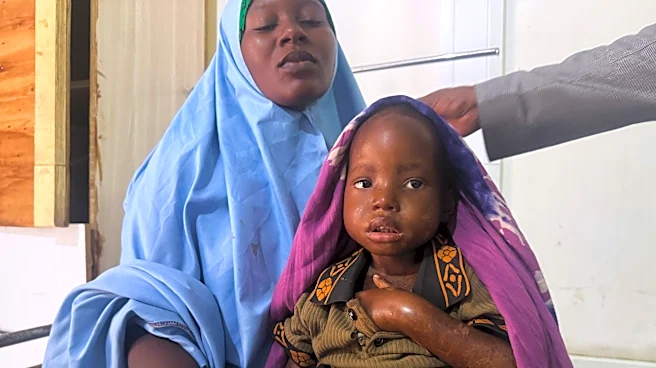
Funding cuts have resulted in the closure of 205 health and nutrition facilities across Somalia, as reported by the United Nations International Children’s Fund (UNICEF) on August 21. This reduction in operational facilities is making it increasingly
difficult for families, particularly those with malnourished children, to access essential care. The closures force individuals to travel greater distances to find medical assistance, exacerbating an already precarious situation. This development occurs as international aid organizations, such as Action Against Hunger, highlight a broader trend of dwindling international funding for food security initiatives. These cuts are compelling aid programs to scale back their operations and reduce emergency food rations, further endangering vulnerable populations.
Why It's Important?
The closure of numerous health and nutrition facilities in Somalia has significant humanitarian implications, particularly for children and families facing malnutrition. The reduced access to care means that preventable and treatable conditions may go unaddressed, leading to increased morbidity and mortality rates. This situation is compounded by the broader context of decreasing international funding for food security, which undermines efforts to build resilience in communities already vulnerable to climate shocks and food shortages. The inability of aid organizations to maintain essential services due to funding shortfalls creates a cycle of dependency and vulnerability, making it harder for affected populations to recover from crises and prepare for future challenges like the anticipated El Niño event.
What's Next?
The immediate future for Somalia's vulnerable populations, especially children, appears grim as the impact of facility closures and reduced aid continues to unfold. Aid organizations are calling for urgent action and flexible funding mechanisms to address the escalating crisis. There is a critical need for increased international support to reopen closed facilities and restore essential health and nutrition services. Furthermore, experts emphasize the importance of early warning systems and community-level planning, supported by adequate resources, to mitigate the effects of impending climate events like El Niño. Without a significant and timely injection of funds, the humanitarian situation is expected to worsen, potentially leading to a more severe and widespread malnutrition crisis.
Beyond the Headlines
The situation in Somalia underscores a deeper global challenge concerning the sustainability and predictability of humanitarian aid. The reliance on fluctuating international funding leaves vulnerable populations in a constant state of uncertainty, where essential services can be abruptly withdrawn. This highlights the ethical imperative for donor nations and international bodies to establish more consistent and flexible funding mechanisms that can adapt to evolving crises and long-term development needs. The closures also expose the fragility of healthcare infrastructure in conflict-affected and climate-vulnerable regions, where even minor disruptions in funding can have catastrophic consequences. Addressing these systemic issues requires a re-evaluation of global aid policies to prioritize proactive, sustained support over reactive, short-term interventions.