








What's Happening?
A recent study published in the journal Science has revealed that early tetrapods, the first land-dwelling vertebrates, did not undergo a tadpole phase as previously believed. The research, conducted by scientists including Jason Pardo from Chicago's
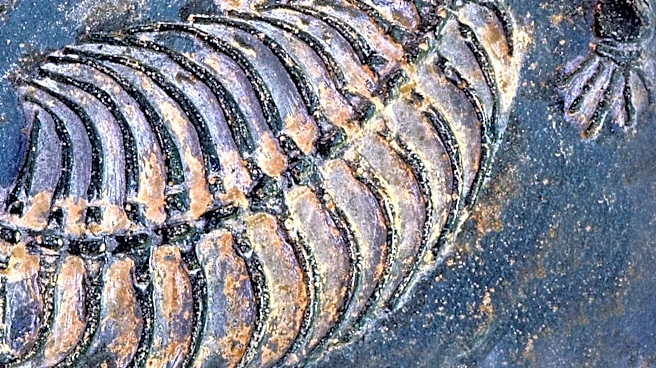
Field Museum, analyzed fossils from the Mazon Creek fossil beds in Illinois. These fossils, dating back 309 million years, include a specimen likely to be a juvenile embolomere, a crocodile-like creature. Contrary to expectations, this specimen showed no tadpole-like features such as external gills, indicating direct development into its adult form. This finding challenges the long-standing assumption that early tetrapods underwent a metamorphosis similar to modern amphibians.
Why It's Important?
This discovery has significant implications for our understanding of vertebrate evolution. It suggests that the life cycle of early tetrapods was more direct than previously thought, bypassing the dramatic metamorphosis seen in amphibians today. This challenges the traditional view of amphibians as relics of early tetrapod evolution, instead highlighting them as highly evolved creatures. The study underscores the importance of fossils in providing insights into evolutionary processes that occur over short periods and in tissues not typically preserved. This research not only reshapes our understanding of evolutionary history but also emphasizes the role of citizen scientists in contributing to significant scientific discoveries.
What's Next?
The findings open new avenues for research into the evolutionary history of tetrapods and the development of vertebrates. Further studies may focus on other fossil sites to confirm these findings and explore the diversity of developmental strategies among early tetrapods. The research community may also investigate the genetic and environmental factors that influenced the direct development of these ancient creatures. Additionally, this study may inspire more collaborative efforts between professional scientists and amateur fossil collectors to uncover further insights into the history of life on Earth.
Beyond the Headlines
The study highlights the ethical and cultural significance of collaboration between professional scientists and amateur fossil collectors. The Mazon Creek site, known for its well-preserved fossils, has been a treasure trove for both communities. This partnership exemplifies how citizen science can contribute to high-impact research, fostering a deeper appreciation for paleontology and evolutionary biology. The findings also prompt a reevaluation of educational narratives around vertebrate evolution, potentially influencing how this subject is taught in academic settings.