





What's Happening?
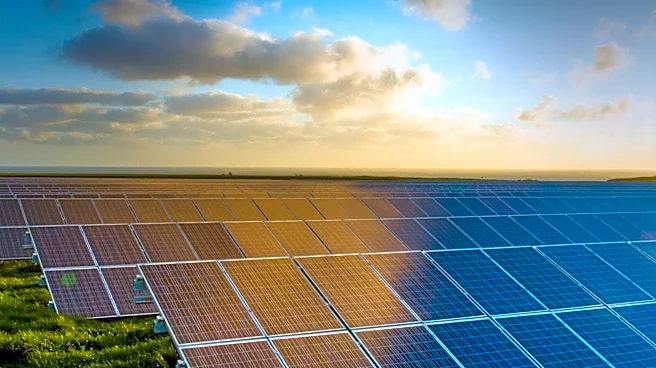
A new study published in the journal Science indicates that China's extensive solar power construction projects have contributed to a decline in bird diversity across the country. Researchers assessed policies promoting solar power and measured bird diversity,
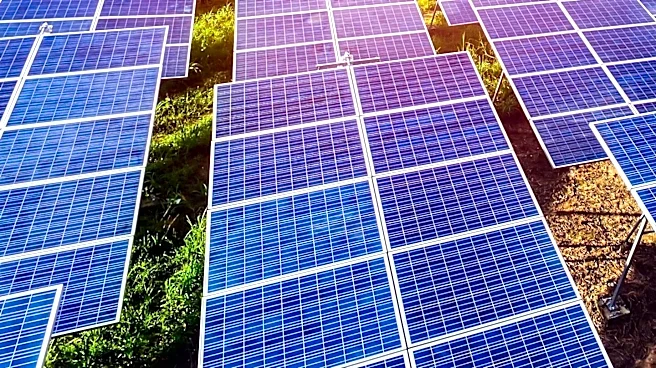
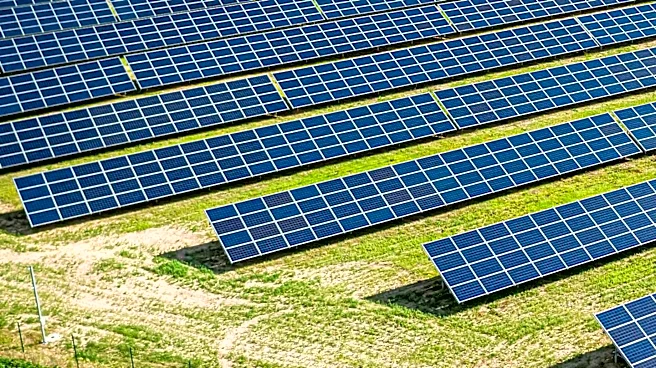
an indicator of ecosystem health, across 2,344 Chinese counties monthly from 2014 to 2023. The study found a modest but systematic decrease in biodiversity, particularly in wealthier, non-arid counties and areas with high numbers of vegetation-nesting birds. No significant negative effect was observed in desert regions or poverty-designated counties. The lead author, Zhang Huiming, a researcher at the Institute of Climate Economy and Low-carbon Industry at Nanjing University of Information Science & Technology, noted that while plant cover increased at solar project sites, this often resulted in 'inferior greening' with dense but homogeneous undergrowth lacking the structural complexity and resource diversity of natural habitats.
Why It's Important?
This study highlights a critical environmental challenge associated with the rapid expansion of renewable energy infrastructure, even as nations strive to combat climate change. While the U.S. is also investing heavily in renewable energy, China's scale of solar panel installation, nearly matching the rest of the world combined, makes its experiences particularly relevant. The findings suggest that without careful planning, the pursuit of clean energy can inadvertently harm biodiversity, a concern that could resonate with environmental policy discussions in the U.S. and globally. It underscores the need for integrated environmental assessments that consider both climate benefits and ecological impacts of large-scale projects. For U.S. policymakers and environmental groups, this research could inform strategies for siting renewable energy projects to minimize harm to sensitive ecosystems and wildlife.
What's Next?
The study's authors suggest that future policies in China could improve environmental outcomes through careful site selection, steering large projects away from ecologically sensitive areas. They also recommend using rooftop solar in habitat-rich regions and restoring diverse native vegetation, rather than relying solely on simple greening targets. China's current policies, such as the Biodiversity Conservation Strategy and Action Plan for 2023 to 2030, already emphasize ecological protection, offering a framework for better coordination between solar development and biodiversity conservation. For the U.S., this research could prompt a re-evaluation of existing guidelines for renewable energy development, potentially leading to more stringent environmental impact assessments and site selection criteria to protect biodiversity.
Beyond the Headlines
The findings from China offer a broader lesson for the global transition to renewable energy, including the U.S. It underscores the complex interplay between climate action and biodiversity conservation, revealing that 'green' solutions can have unintended ecological consequences if not implemented thoughtfully. The concept of 'inferior greening' highlights that simply increasing plant cover is not always equivalent to restoring ecological health; the quality and diversity of vegetation are crucial. This study encourages a more holistic approach to environmental policy, where climate goals are pursued in conjunction with robust biodiversity protection measures. It also prompts a re-examination of how 'citizen science' data can be effectively integrated into large-scale environmental assessments, offering a model for other countries.