




What's Happening?
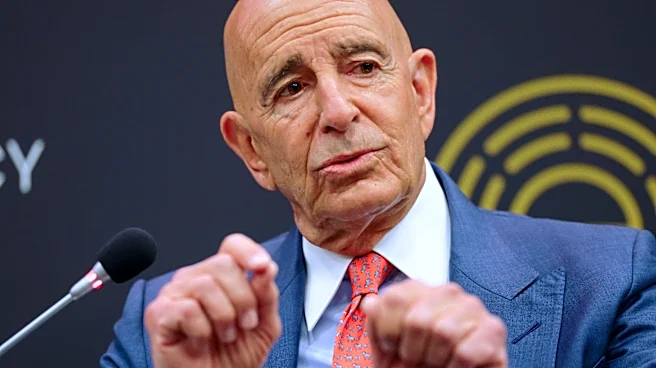
US Special Envoy to Syria and Ambassador to Turkey Tom Barrack has clarified his recent remarks regarding the Golan Heights and Hezbollah disarmament, emphasizing that his comments do not signify a change in U.S. policy. Barrack had previously stated
that Israel 'still' occupies the Golan Heights, which appeared to contradict President Trump's 2019 decision to recognize Israeli sovereignty over the territory. In a statement to The Associated Press, Barrack clarified that his reference to 'occupation' was merely a description of the territory's historical status, and that U.S. policy on the Golan, set by President Trump in 2019, remains unchanged. He also addressed speculation that he was suggesting Iran and Hezbollah should participate in U.S.-backed negotiations between Israel and Lebanon over an Israeli withdrawal and Hezbollah's disarmament. Barrack explicitly rejected this interpretation, stating that Hezbollah is a designated foreign terrorist organization and the U.S. does not negotiate with it. He explained that Iran's role is due to its financial and material support for Hezbollah, making the issue more complex.
Why It's Important?
This clarification is important for maintaining the consistency of U.S. foreign policy and managing diplomatic relations in the Middle East. President Trump's recognition of Israeli sovereignty over the Golan Heights was a significant policy shift, and any perceived deviation from this stance could create uncertainty among allies and adversaries alike. The U.S. stance on Hezbollah, as a designated foreign terrorist organization, is a cornerstone of its counter-terrorism efforts in the region. Any suggestion of negotiating with Hezbollah could undermine these efforts and send a confusing message to international partners. The U.S. plays a critical role in mediating regional conflicts, and clear, consistent communication is essential to its credibility. This incident highlights the sensitivity of diplomatic language and the potential for misinterpretation, especially in a volatile region like the Middle East. The U.S. administration's ability to articulate and maintain a coherent foreign policy is crucial for its influence and the stability of its alliances.
What's Next?
Following this clarification, it is expected that U.S. diplomatic efforts in the region will continue to align with President Trump's established policies regarding the Golan Heights and the non-negotiation stance with Hezbollah. The U.S. will likely continue its efforts to facilitate negotiations between Israel and Lebanon, focusing on an Israeli withdrawal and the disarmament of Hezbollah, without direct engagement with the latter. Future statements from U.S. envoys and officials will likely be carefully scrutinized to ensure they reflect the official U.S. position. The incident may also prompt internal reviews within the U.S. State Department to reinforce communication protocols and ensure all representatives are aligned on sensitive policy issues. Regional actors, including Israel, Lebanon, and Iran, will observe these developments closely, and their reactions will shape the ongoing dynamics of the Middle East. The U.S. will continue to navigate the complex geopolitical landscape, balancing its strategic interests with the need for regional stability.
Beyond the Headlines
Beyond the immediate diplomatic implications, this event underscores the persistent challenges of defining and maintaining international borders and sovereignty in contested territories. The Golan Heights, like many other areas in the Middle East, carries a complex history of conflict and competing claims, making any definitive resolution difficult. The U.S. recognition of Israeli sovereignty over the Golan was a departure from long-standing international consensus, and any perceived wavering on this stance can reignite debates about international law and territorial integrity. Furthermore, the issue of Hezbollah's disarmament is deeply intertwined with regional power struggles, particularly the influence of Iran. The U.S. policy of isolating and sanctioning Hezbollah reflects a broader strategy to counter Iranian expansionism. The ongoing efforts to disarm Hezbollah, even without direct negotiation, highlight the enduring challenge of confronting non-state actors that wield significant military and political power, often with external state sponsorship. This situation reflects the intricate web of historical grievances, geopolitical rivalries, and the constant struggle for influence that defines the modern Middle East.