
What's Happening?
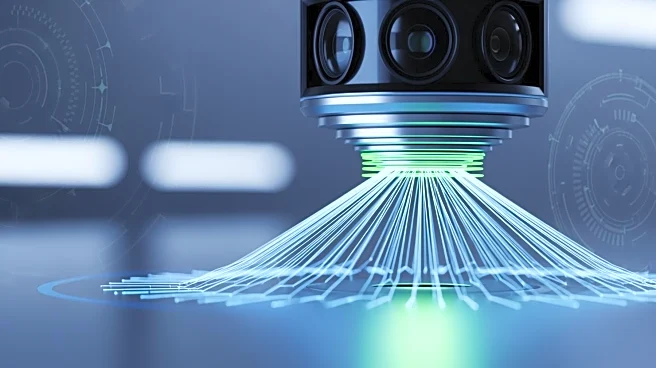
Researchers in China have developed a bionic LiDAR system that surpasses human retinal resolution through adaptive focusing. Published in Nature Communications, the study introduces a chip-scale LiDAR system that mimics
the human eye's ability to concentrate high-resolution sensing on regions of interest while maintaining broad awareness. The system achieves an angular resolution of 0.012°, twice as sharp as the human eye, by reallocating sensing channels dynamically. This approach avoids the high costs and complexity associated with traditional LiDAR systems that use uniform resolution across all channels.
Why It's Important?
The development of this bionic LiDAR system represents a significant advancement in machine vision technology. By improving resolution and efficiency, the system has potential applications in autonomous vehicles, drones, and robotics, where precise environmental perception is crucial. The ability to dynamically focus on important areas while maintaining overall awareness could enhance the performance and safety of these technologies. This innovation also addresses the challenges of scaling LiDAR systems, offering a more cost-effective and energy-efficient solution.
What's Next?
The research team plans to further develop the technology for practical deployment, focusing on integrating the system onto thin-film lithium niobate platforms for improved stability and performance. Future work may also explore the use of ultra-wideband swept sources for enhanced range resolution and the implementation of closed-loop attention policies for event-driven perception. These advancements could lead to broader adoption of the technology in various industries, enhancing the capabilities of machine vision systems.
Beyond the Headlines
The study highlights the potential for biomimicry in technological innovation, drawing inspiration from the human eye to improve machine vision systems. By mimicking biological processes, researchers can develop more efficient and effective technologies that address current limitations. This approach underscores the value of interdisciplinary research, combining insights from biology, engineering, and physics to drive technological progress.