


What's Happening?
In May 2024, a significant geomagnetic 'superstorm' caused by high solar activity led to the appearance of the aurora borealis in various locations, including as far south as Hyogo prefecture in Japan. During and after this event, the Japanese radiation
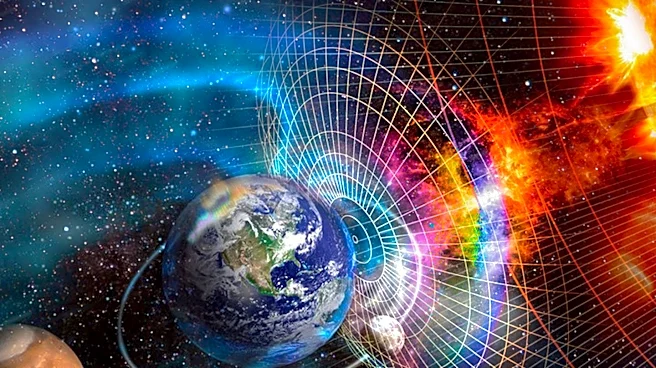
space probe Arase, operated by JAXA, collected data from within a region of space previously thought to be an 'impenetrable barrier' against highly energetic electrons. The probe detected a large flux of high-energy electrons, some exceeding three megaelectronvolts, moving close to the speed of light, effectively breaching this barrier. Research led by Nagoya University, published in Geophysical Research Letters, indicates that these electrons were accelerated locally within this region rather than being transported inward from outer radiation belts. This local acceleration was supported by the analysis of electron phase space density (PSD) and the detection of intense 'chorus waves' by Arase, which are low-frequency electromagnetic waves that can transfer energy to electrons.
Why It's Important?
This discovery challenges previous understandings of Earth's magnetosphere and its protective capabilities against energetic electrons. The 'impenetrable barrier,' first identified in 2014, was believed to prevent such electrons from reaching closer to Earth, safeguarding spacecraft and their electronics. The presence of ultrarelativistic electrons within this barrier, as observed during the 2024 superstorm, signifies a potential increase in radiation risks for satellites and other space hardware operating in seemingly protected regions. This has direct implications for the design and shielding requirements of future spacecraft, particularly those in low to medium Earth orbits. Furthermore, the findings highlight the critical need for improved space weather prediction models to better anticipate and mitigate the effects of severe solar events on space infrastructure, which is vital for communication, navigation, and various scientific endeavors.
What's Next?
The findings necessitate a deeper understanding of how energetic electrons behave under extreme space weather conditions. Researchers will likely focus on refining models to predict the occurrence and intensity of such electron enhancements within Earth's magnetosphere. This will involve continued observations from space probes like Arase and potentially new missions designed to monitor the 'impenetrable barrier' and the dynamics of the plasmasphere. The insights gained will be crucial for developing more robust radiation-hardened components for spacecraft and for implementing more effective operational strategies during periods of high solar activity. International collaborations will be essential to integrate data from various sources and improve global space weather forecasting capabilities, ensuring the safety and longevity of space assets.
Beyond the Headlines
The breach of Earth's 'impenetrable barrier' by ultrarelativistic electrons during the 2024 solar superstorm underscores the dynamic and unpredictable nature of space weather. This event reveals a vulnerability in our understanding of the near-Earth space environment, suggesting that even well-established scientific concepts can be challenged by extreme natural phenomena. The ethical implications extend to the increasing reliance on space-based technologies for daily life, from GPS to internet connectivity. A more frequent or intense occurrence of such events could lead to disruptions in these services, impacting economies and societies globally. This research also highlights the continuous interplay between solar activity and Earth's protective magnetic field, emphasizing the need for ongoing scientific inquiry to adapt to and prepare for the evolving challenges posed by our cosmic environment.